The beauty of Bordeaux wines: each vintage follows the next, yet no two are ever alike
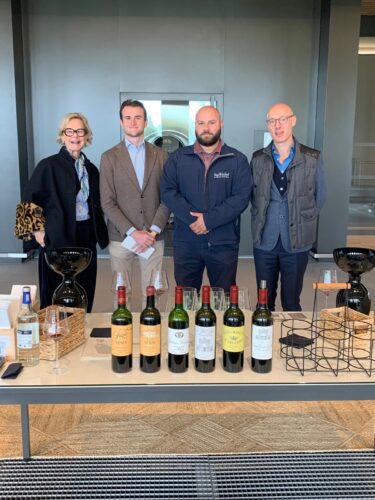
Reading back over my notes on the 2025 vintage, one thing becomes clear: one could almost write the exact opposite of 2024.
In 2024, excessive rainfall during ripening forced some châteaux to delay their harvests with great care. In 2025, the situation was reversed: in the vineyards, one could almost imagine rain dances, pleading with Mother Nature to water the parched soils. Drought defines the vintage.
Opposite in their development, the two vintages nevertheless converge on one point: volume. 2025 stands as the smallest vintage since 1991 — a statement that already applied to 2024. In Bordeaux, a pressing question now arises: can great, even very great vintages — as 2025 appears to be — still coexist with generous yields, as in 2016?
Let us remain optimistic. 2025 is a beautiful vintage, which comes as a relief for the entire industry. Yet a deeper question lingers: does “normal” still exist in viticulture in an era of climate disruption?
During the tastings of Canon 2025 and Rauzan-Ségla 2025, I put this question to Nicolas Audebert. How can such quality be explained, when the growing cycle was shorter and the harvest particularly early — a trend widely observed across Bordeaux?
His answer rests on two points: an earlier start to the cycle, and a vine that once again demonstrated its resilience and capacity to adapt, especially on great terroirs.
In the glass, this is strikingly evident. Rauzan-Ségla reaches a level I had never before seen at the Primeurs: drive, precision, Margaux finesse, without losing any of its identity or structure. Canon, for its part, achieves a remarkable purity in its limestone expression.
And then, almost at the last moment, came the rain — a gift from the sky, arriving between late August and early September, perfecting the ripening process.
Words from the experts: Three oenologists/consultants kindly took the time to answer four questions
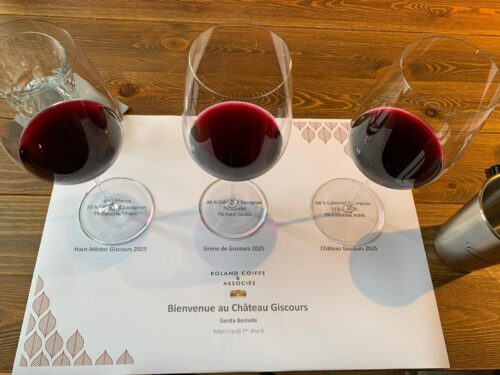
“What was the biggest challenge for winegrowers in 2025?”
Eric Boissenot : Overall, the year was fairly easy from a vineyard perspective: no major disease pressure, low mildew risk, and the vines coped well with the drought — likely even better than in 2022.
Thomas Duclos : Most likely, the biggest challenge was staying calm and level-headed towards the end of the growing cycle, which saw a heatwave around mid-August followed by rainfall in early September.
Julien Viaud : With hindsight, this vintage was much easier than others. Spring and summer conditions were generally favourable. The greater challenge came in the cellar, where it was essential to manage the richness of the material. The fruit was abundant and concentrated, and the winemaker’s role was to be precise, measured, and restrained in order to express the very best the grapes had to offer.
“Could you share a few thoughts on the 2025 yields?”
Eric Boissenot : Yields were low, even very low. This was due, on the one hand, to limited floral initiation (resulting in fewer bunches), and on the other hand to small berry size at harvest (across all grape varieties), caused by the low rainfall throughout the vintage.
Thomas Duclos : The 2025 vintage was affected by a low number of bunches — a direct consequence of the 2024 conditions (poor floral induction) combined with a dry growing season. The result is therefore low yields.
Julien Viaud : Yields in 2025 were not high, mainly for physiological reasons. The issue is that both the size and number of bunches — determined the previous year within the buds — were limited from the outset. The potential was therefore already constrained.
Fortunately, the vintage conditions were highly favourable: flowering took place under sunny and breezy conditions, the climate was generally benign with low disease pressure, there was sufficient water availability, and few extreme heat events causing hydric stress. This allowed for moderate yields, though certainly not excessive.

“How would you describe the style of the 2025 vintage?”
Eric Boissenot : First of all, it is a very early vintage, shaped by a warm and dry climate. It then benefited from rainfall in late August and early September, which helped the vines manage water stress. As a result, alcohol levels remain moderate (around 13–13.5% vol) for a warm year. While it shows a warm and very ripe character, it also retains a classic, distinctly Bordeaux style that is both balanced and highly drinkable.
Thomas Duclos : 2025 is a Bordeaux vintage shaped by climate change.
Julien Viaud : It is a sunny vintage, but not “solar” in the sense that it allowed for ripe grapes full of fruit expression, without excessive sugar (and therefore alcohol), and without a loss of acidity (and thus freshness). It is an approachable, generous, and charming vintage, with wines bursting with aromas and delivering real pleasure.
“If you had to sum up 2025 in one word or a short phrase, what would you choose?”
Eric Boissenot : High density
Thomas Duclos : Futuristic.
Julien Viaud : Intense and fast-paced — we have rarely harvested so quickly. Harvesting and winemaking followed one another seamlessly, with little need for overthinking.
Conclusions
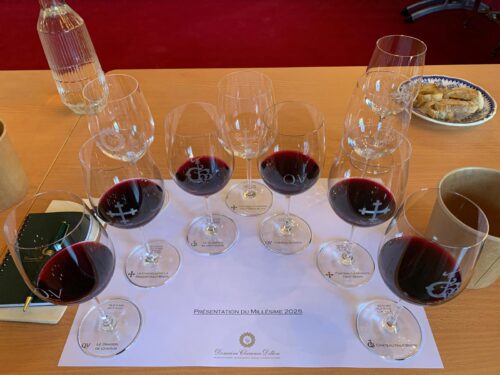
- Reds: Well-balanced wines, showing fine concentration and the freshness so characteristic of Bordeaux — perhaps, as Julien Viaud suggests, a style the world might envy. They retain a solid yet never heavy tannic structure, resulting in wines that are both vibrant and structured. A beautiful vintage, even exceptional in certain cases.
- Whites: The first grapes arrived at the cellar as early as August 11! The wines are highly expressive, with good mid-palate weight and a certain creaminess. They also stand out for their freshness, which brings energy and lift.
- Sweet wines: This is not the lowest-yielding vintage for sweet wines, unlike 2021, when the harvest was historically small. When the rains came in late August / early September, the grapes were in excellent health, allowing Botrytis cinerea to develop evenly. The style is rather opulent, with lovely complexity.