“We are partners of La Place and we are committed to the long term”
Here we present the last part of our trilogy dedicated to the finances of the wine industry in Bordeaux.
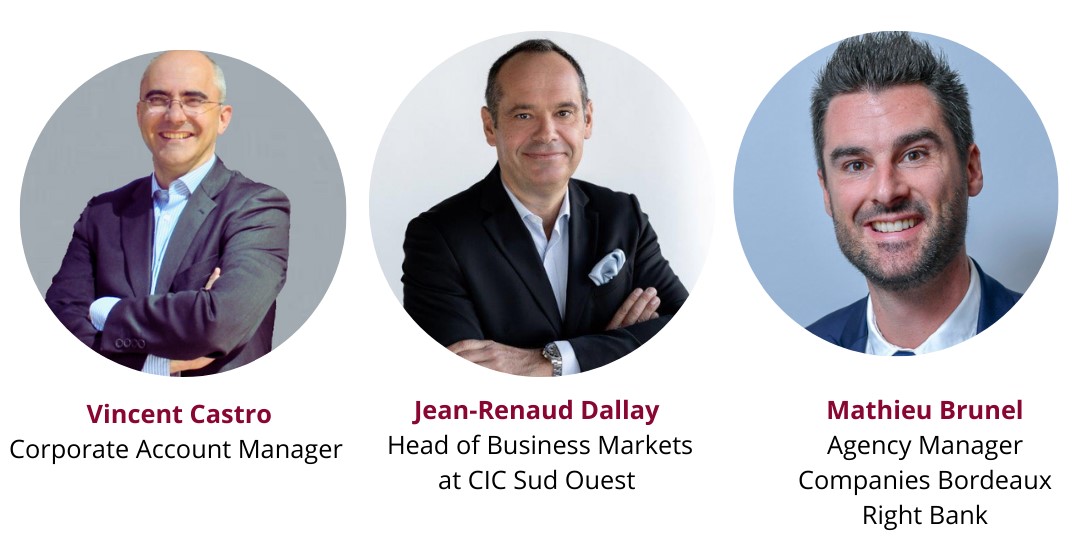
Jean-Renaud Dallay, Corporate Market Director of CIC Sud-Ouest, Mathieu Brunel, Corporate Branch Manager and Vincent Castro, Corporate Relationship Manager at CIC Sud-Ouest bank, discuss the importance of collaboration between banks and companies in the sector to ensure their long-term financing.
Gerda: Can you give us an overview of the role of banks in supporting the Bordeaux wine industry?
Jean-Renaud Dallay: We are present throughout the value chain of the wine industry, we have among our customers suppliers, producers, brokers, merchants, wine merchants. Our outstanding financing is fairly concentrated towards “large estates” and merchants. We support our clients by financing their investment projects which may concern land acquisitions, plantations, investments in equipment, cellars, we are also very present in the financing of stock carrying or early guarantees. We also work with dedicated teams on structuring transactions involving property acquisitions, family transfers, etc.
Mathieu Brunel: We even go so far as to support our clients internationally. This is one of the strengths, the strength of our group.
JRD: Yes, CIC Sud-Ouest is a bank that belongs to the Crédit Mutuel Alliance Fédérale Group, which is one of the largest French and European banking groups.
Their field of intervention is quite broad and depends on the mission entrusted to them. For example, they make it possible to identify new customers in a given market, to find suppliers, reliable advice, and to support new establishments both on the industrial and HR levels. Our commitment to supporting our clients in their international activities is deeply rooted in our approach.
Economic Impact of Wine in Our Region
GB: How do you assess the economic impact of the wine industry on the Bordeaux region?
JRD: The economic impact of the wine industry on the Bordeaux region is very important for our territory and multidimensional. There are of course the wine estates and trading houses, which are major players in the regional economy, but also all the activities that revolve around it, whether they are suppliers of inputs, equipment, agricultural labour, and networks of wine merchants. The construction of cellars, some of which were spectacular, by some large estates, also supported the activity of construction companies and specialized architectural firms.
MB: The turnover of the wine industry in the region is between 4 and 4.5 billion euros per year, generating many local jobs and supplying the Bordeaux economy with liquidity. Unlike other industries, such as aeronautics, where the turnover can be largely generated abroad, the wine industry generates and maintains its value locally. This translates into a high local profitability, similar to that of tourism, which not only supports the regional economy, but also enhances and preserves Bordeaux’s cultural heritage.
GB: How do you assess the financial state of the Bordeaux financial centre?
JRD: It is difficult to generalize because our sector encompasses different universes. There are large properties that can be backed by large families or large groups. Even if they have to carry the wines, they have the necessary resources, which does not pose any major difficulties. For smaller properties, it is often more complicated, especially for those who sell mainly to large retailers. These owners are often strangled by the increase in production costs (dry materials, wages, etc.) and do not have the ability to pass on these price increases.
Between these two extremes, there are properties that sell less well and have to deal with rising costs. The situation is not simple. We have a role to play in supporting them to help them get through this stage.
As for trading, some operators had taken advantage of the post-covid period during which the cost of money was close to zero to build up strategic stocks that were intended to be carried to be valued later. This strategy is now being undermined because the Euribor, the benchmark CT index, is now close to 4% with some prospects of decline, but it will never return to what we have known. Free money is over! This sudden increase in short-term interest rates has had a direct impact on the cost of carrying wines and therefore on the margin. The last en primeur campaign, whose release prices were significantly revised downwards even though the vintage is of high quality, raises the question of the valuation in the stocks of previous vintages bought at too high a price. This deflationary trend should not continue unless the en primeur model is called into question, what is the point of carrying wine to sell it at the same price in two or three years?
There have been other crises. We support our customers in good times, but also in more difficult times. We are partners of La Place and we are committed to the long term.
Financing & Investment
G: What are the main challenges that vineyard owners and merchants face?
JRD: We feel a lot of concern among our customers. The recent sharp increase in interest rates has had a significant impact. Properties and merchants, who carry large inventories over several years, are now seeing their carrying costs increase significantly. While the Euribor rate was previously at 0%, it is now close to 4%. This increase in the cost of carry, which is very difficult to pass on to the final price in the market context we are experiencing, therefore has a direct impact on the margin and destabilizes the market.
Climate change is another challenge that winegrowers have to face, it has an impact on the product with, for example, a tendency to increase the alcohol content but also on yields which are impacted by climatic hazards (drought, frosts, hail, mildew, etc.). CSR-related constraints also have consequences on production costs and investment needs.
There is also a certain “disenchantment” with Bordeaux to the detriment of wines from other regions. How can we justify that even here, in Bordeaux, some restaurants do not have Bordeaux wines on their menu. This is not acceptable! We should be proud of our products. We have to find a solution to promote our terroir and succeed in attracting this young generation who consume wine differently. In Bordeaux, we are quite conservative by nature, which has its advantages, but for this generation, the wine should be drunk fresher, fruitier, and simpler as an aperitif. We have to seduce the consumer of tomorrow. All these phenomena, which have been underway for a long time, have a very significant impact on the sector today.
MB: We have to break the old codes. There is also a change in taste. The market is demanding less “oaky” wines with more liveliness, which requires a change in logistics, and the problem is that the world of wine is slowly evolving. The decisions made today will have an impact in 10 or 15 years, but tastes have already changed. There will be a transition in the way the sector will evolve with these new trends.
It must also be said that our wines are not expensive. Sometimes, we have this French side of denigrating ourselves. We should be proud of what we produce and learn to play more on the notion of branding. For me, it’s not just a question of price. By playing only on prices and discounts, we are on the wrong track and we are strangling all market players, thus reducing margins and destabilizing the consumer.

Trends & Innovations
GB: Have you observed any trends or innovations in the wine industry’s funding requests in recent years?
JRD: We are able to offer financing with subsidized rates when it is allocated to investments that have a positive impact on the carbon footprint. As far as the financing of the carrying of stocks is concerned, there has been no major innovation, we continue to base our short- or medium-term financing on the value of the stocks. The needs in this area have not changed much except that in the context we are experiencing, stocks are changing more slowly, so the need for carry financing is increasing, whether at the level of trading and/or properties.
MB: Yes, in terms of the typology of the requests, they remain similar, but the overall amounts of the budgets are much larger than before. We always have requests for porterage, the construction of cellars, the planting of vines, the purchase of winemaking tools, etc. The big difference is the significant increase in the amounts of funding requested. The real innovation in financing in recent years has been loans benefiting from subsidized rates as long as the object financed has a positive impact on CSR.
International Markets
GB: What role do banks play in helping traders and owners navigate market fluctuations?
JRD: The notion of advice does not seem to me to correspond to reality. We, at CIC Sud-Ouest, remain above all generalist bankers. They are our most expert customers. They know the solutions better than we do. They know that you have to diversify, export, value your product through price, etc. Our job is to support these projects in good conditions for the bank and the customer by integrating, for example, climatic hazards into the forecasts (provision of half a harvest every 4 or 5 years) and to support our customers in their projects.
Vincent Castro: We can give food for thought, anything that goes in the client’s direction, such as diversification and risk spreading. We can also advise owners to think about offering their products to other traders, to open up to other countries if they are too concentrated in a few geographical areas.
JRD: The consulting part focuses only on the aspects that we know how to master.
If a major investment project is being studied by one of our clients, we can intervene by providing our expertise on the structuring of the operation, we can give indications on what will be “financeable” by a bank and what will not be or more difficult. In the event of the acquisition of properties, plots, transfer operations, or capital restructuring, we call on our specialists (wealth engineers, structured finance project managers) who provide their know-how.

G: Many properties have been sold to Chinese investors. Have you seen a different profile of buyers lately?
JRD: For many years, we have observed a sustained interest from institutional investors in Bordeaux.
These investments by large groups in Bordeaux properties have contributed to a significant inflation in land prices. During this period, many properties changed hands, some were bought from families who had owned them for several generations. In France, the transfer values of these properties are based on the value of the land.
However, there is often a significant gap between the value of the asset and the income it generates, which makes it complex and sometimes impossible to buy back shares between brothers and sisters. If we want these properties to remain family-owned, then it is essential to anticipate and use all the legal and tax levers that allow them to pass on their property while benefiting from allowances and exemptions. Banks, such as lawyers, notaries, have a full role to play in these operations.
G: Without going into details and without making a commitment, how do you assess the financial situation of RCA?
VC: It is a major player in the market that has been remarkably successful over the past 15 years. It is a long-standing partner of the CIC.
JRD: Indeed, we are proud to have accompanied Roland Coiffe since its beginnings. It is a trading company with an exceptional track record. There is little equivalent. For us, it is a reference.

Gerda BEZIADE has an incredible passion for wine, and has a perfect knowledge of Bordeaux acquired within prestigious merchants for 25 years. Gerda joins Roland Coiffe & Associés to bring you more information about the properties we market with “Inside La PLACE“.