Gerda: Can you tell us a little about yourself?
Bernard Burtschy: I have two careers. One is in wine, where I’ve been working for almost 40 years. I joined the Revue des Vins de France in 1993, and I also have an academic career: I’ve taught artificial intelligence and data mining, which has nothing to do with wine. It was through this second career that I met Michel Bettane, a great taster, and it was he who introduced me to the world of wine.
G: What is your overall impression of Château Pichon Comtesse de Lalande?
BB: Pichon Comtesse de Lalande is a château I’ve been following closely for a long time. I knew the former owner, Madame de Lencquesaing, very well, and not only did she produce a wine that cannot be ignored, she also represented the estate around the world.
I think you always have to place a wine in its time. At the start of my career, I used to buy wines like 1992, 1993 or 1994, which weren’t expensive at all. It was a bit like buying a wine in a plastic bottle today. So I bought Gruaud Larose, Brane-Cantenac and, of course, Pichon Comtesse. I learned about these wines from small vintages, at a time when Bordeaux was going through a major crisis. They were very accessible. In retrospect, they seem to have lacked substance, but every wine has something to say. It’s all a question of context and tasting style. These wines forged my taste.
G: But if you had to describe Pichon Comtesse in a few sentences?
BB: Pichon Comtesse de Lalande has a certain duality about it. It’s a Pauillac, but it differs from the classic image of the appellation, often associated with powerful, tannic, sometimes austere wines. On the contrary, it wraps this strength in an almost unsuspected softness. In the past, it contained a high proportion of Merlot and relatively high yields, as was customary at the time. Hence the importance of always putting a wine into context. Pichon Comtesse thus combined depth with immediate accessibility. For a neophyte palate like mine at the time, it was a revelation. It captured my interest early on, and the 1982, 1985 and 1989 vintages remain among my first great emotions. I had the privilege of coming to the château, hosted by Madame de Lencquesaing, but I also tasted these wines many times elsewhere. They always seemed marvellous.
G: Do you think there’s a Pichon Comtesse style?
BB: Yes, all the more so when you compare it to Pichon Baron, its immediate neighbor. Pichon Baron embodies an austere, upright, strict Pauillac, at least before AXA became the owner. Pichon Comtesse, on the other hand, thanks to its high proportion of Merlot, has always been more accessible. What has always fascinated me is the duality between apparent suppleness and real density and depth. This balance still exists, even if today we’re trying to produce even more ambitious wines. This identity is one of Pichon Comtesse’s strengths, which is not very common in the Médoc. There’s always been that sweetness provided by Merlot. Some will say it’s the easy way out, perhaps. But it was damn well done! There was always a remarkable technical team behind it. By contrast, Latour is much stricter. With Pichon Comtesse, you can take a bottle to a friend’s house, and everyone will think it’s wonderful.
G: Nicolas talked to us about organic and biodynamic viticulture. Do you think this type of viticulture influences the style of the wine?
BB: I’m particularly familiar with these practices, because with my wife, we had a vineyard that was certified organic and biodynamic, under the Demeter and Biodyvin labels. Today, I think there’s no other way. Sometimes it’s better to go straight to biodynamics without an organic intermediate step. In biodynamic viticulture, certain herbal teas limit the use of copper, which makes the problem secondary. For me, true biodynamics is what my grandfather practised: it was all about anticipating. With perfect anticipation, the problem no longer arises. Today, we have the added advantage of very precise weather forecasting. As soon as a certain threshold of precipitation is reached, we know we need to treat, and we know precisely when the rain will arrive. Of course, some years are very rainy, and whatever happens, we have no choice… but the same is true of conventional viticulture.
As far as Pichon Comtesse de Lalande is concerned, I find that since its conversion to organic, the wine has gained in diversity and depth. This is true for all wines, but it’s not enough. One of my great disappointments in tasting Demeter-certified wines is that one out of every two is of no interest at all. Just because you practice organic or biodynamic agriculture doesn’t guarantee a well-made wine. Nevertheless, I think that in ten years’ time, everyone will be organic or biodynamic. We won’t have a choice anymore.
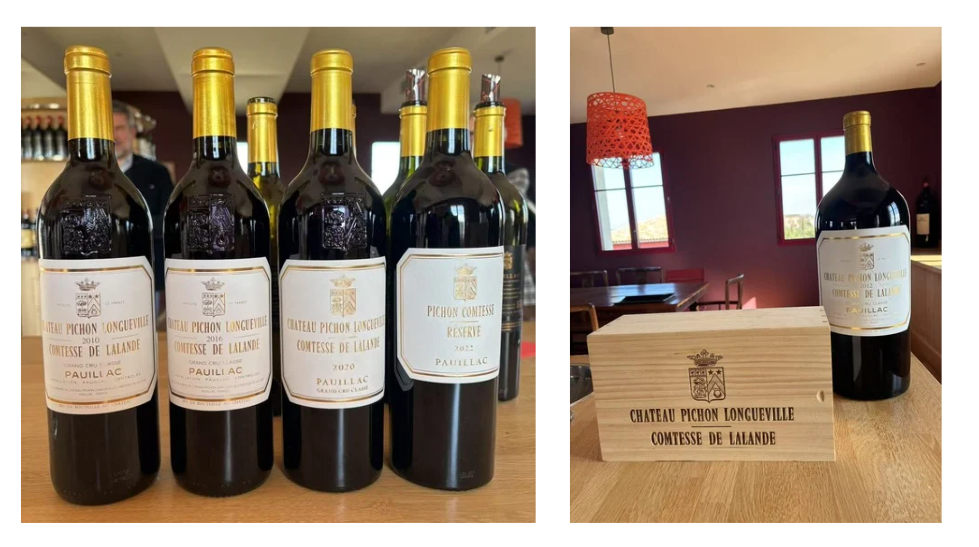
G: We started the tasting with Réserve de Comtesse 2022. What do you think?
BB: It’s great. It’s even superior to the Grand Vin of ten years ago. It has both the velvety smoothness and depth that characterize Pichon Comtesse. Today, we find these qualities in the second wine, but with an unprecedented fullness and length. For me, this is one of Bordeaux’s greatest second wines.
G: Yes, I couldn’t agree with you more. It’s a great wine, with the added advantage of being delicious when young. The next wine was Pichon Comtesse 2020, a great Bordeaux vintage, the last of the 2018-2019-2020 trilogy. What do you think?
BB: It’s a wine in constant evolution, from the en primeur tasting to today’s bottling. It’s always been great, but at the moment it’s going through a phase of closure.
G: Yes, I’ve also written that he hasn’t fully expressed himself yet.
BB: It’s following a classic evolution, and I think it will remain closed for another four or five years. Basically, I place the 2022 vintage above the 2020. The 2022 has both more depth and extra velvetiness. It’s a vintage that has everything. Nevertheless, the 2020 remains a great bottle. Even though it is currently going through a phase of closure, it remains relatively accessible, even if it has become more typically Pauillac.
G: But didn’t this trend for Pichon Comtesse to become more Pauillac really start with the significant increase in the percentage of Cabernet Sauvignon, with a few exceptions, as Nicolas mentioned?
BB: Yes, this wine is cut out for a great career and is fully in line with Bordeaux classicism. But if you want to taste it today, you absolutely must decant it to rediscover the openness it had six months ago. It has exceptional density, but will need a little time to refine. Each vintage has its own style, like Pichon Comtesse 2016, which is distinguished by a more marked freshness.
G: The 2016 is one of the greatest vintages ever made in Bordeaux. I wrote of this magnificent 2016 Pichon Comtesse that it offers perfect balance, with exceptionally structured elegance and an impressive finish. This is a great Pichon Comtesse, carried by a noble uprightness.
BB: Yes, this vintage has everything. For me, it has the style of the 2020, but with a touch more freshness. When a Pauillac has that touch of freshness and it doesn’t evoke greenness, which is the case here, it makes it even greater. This is a great wine, destined for glory. There will be those who prefer the 2020, which is fundamentally more velvety.
G: The 2020, more velvety?
BB: Yes, although it’s closing up now. The 2016 will always be fresher, and therefore more Pauillac. Pichon Comtesse has always oscillated between two identities: am I a Pauillac or am I a Pichon Comtesse? For a long time, he chose his camp, as in 2000, 2001 or 1985, when he displayed the very charming side of Merlot, while retaining a certain uprightness in the background. Today, this straightforwardness has taken over. Inherently, the strength of Medoc and Pauillac lies in Cabernet Sauvignon. Wherever Cabernet Sauvignon is grown, such as in Napa Valley, it reaches its highest level, but it’s in Pauillac that it’s at its greatest. For me, that’s indisputable.
G: Should you always keep a small share of Merlot in the blend, both because of the terroir, as Nicolas explained, but also to round out the Cabernet Sauvignon?
BB: Yes, there are clay areas even in Pauillac. For example, Pibran, which has 50% Cabernet Sauvignon and 50% Merlot, because its soil contains a high proportion of clay. But Pichon Lalande is a great Pauillac, situated on gravel. It is on this terroir that it achieves its refinement and elegance. The famous fourth terrace, also found at Latour and Montrose, produces wines that are both dense and refined. It is the vines planted on this terrace that produce the most elegant wines.
G: Nicolas also mentioned that he had greatly reduced the proportion of petit verdot.
BB: Yes, this grape variety has long been a trademark of Pichon Lalande. In fact, there were some magnificent small verdots planted in the 1930s. Obviously, these plots have aged and have been uprooted. There are vintages when the influence of Petit Verdot is clearly felt, as in 2001, when it represented 14% of the blend. But in the long term, we know that Petit Verdot doesn’t have the class of Cabernet Sauvignon. For the first 10 to 15 years, it brings color, tannin and diversity, but on the Pichon Lalande terroir, when you have great Cabernet Sauvignon, there’s nothing better. It’s no longer necessary to reinforce the wine today.
G: It’s certainly also linked to climate change, which favors Cabernet Sauvignon.
BB: Yes, and also Petit Verdot runs out of steam after 15 to 20 years of age.
G: The last vintage we tasted was Pichon Lalande 2010.
BB: The 2010 is a great vintage, in parallel with the 2009, which is more accessible and often superior on the Right Bank, in my opinion. The 2010 went through a rather unpleasant phase, but it’s now coming out of it and starting to taste very well. At the time, it had significant tannin mass, which is still present today, even in Pichon Comtesse. The tannins are imposing, but no longer aggressive. In Parker’s day – and we were in the middle of it then – some winemakers were making very extracted, woody wines. Pichon Comtesse has never fallen into this excess, and that’s why this wine is magnificent.
G: Yes, and it’s never been in Pichon Comtesse’s DNA to produce over-extracted wines..
BB: Exactly, and with a high proportion of Merlot, we’ll never have the same tannic mass as with Cabernet Sauvignon. For me, the 2010 is starting to reach its peak. It’s a more complete wine than the 2009. The choice between these two vintages depends on the vintage: you have to discuss it wine by wine.
G: Already for the 2010?
BB: Yes, little by little, he’s reaching a new stage, and it’s now clear where he’s heading. And I’m sure it will remain at its peak for a long time to come.

GerdaBEZIADE has an incredible passion for wine, and a perfect knowledge of Bordeaux acquired over 25 years with prestigious wine merchants. Gerda joins Roland Coiffe & Associés to bring you“Inside La PLACE” even more information on the properties we sell.