Félix Pariente-Lorenzetti
President of Château Pédesclaux, Château Lafon-Rochet & Château Lilian Ladouys
Domaines Lorenzetti
Gerda Beziade : Tell us a bit about yourself.
Félix Pariente Lorenzetti : Although I was born in Bordeaux, I spent a large part of my youth in Paris and the United States, particularly in California, where I lived for a year at the age of 16. After high school in Paris, I studied at the Lausanne Hotel School and completed an initial internship in hospitality, followed by another at Hermès in New York, working in finance and marketing.
At the beginning of my career, I worked in France, but my taste for adventure led me to move to New York. I joined the Barnes group, where I was involved in developing a hotel project in partnership with Michelin-starred chef Daniel Boulud. After less than a year at Barnes, I decided to launch my own entrepreneurial venture by founding a textile brand in New York. However, just as I was about to begin production, my uncle Jacky offered me the opportunity to join the family estates, which I immediately accepted. I therefore left New York and moved to Saint-Estèphe.
GB : During your studies at the Lausanne Hotel School, did wine already play an important role in your life?
FPL : Yes, I took oenology courses and worked several summer jobs in restaurants, notably as a host and waiter during events in Paris. I have always been passionate about the world of wine.
GB : What are the main challenges you face in your profession today?
FPL : There are many. Today, it is essential to generate consumer interest in wine, especially Bordeaux wines, given the huge number of producers around the world. One of the major challenges is making people aware of the incredible value for money that Bordeaux wines offer.
We also need to attract younger generations, because a large proportion of our current consumers are over 65 years old. In 30 years, we risk losing them, so it is crucial to appeal to new consumers who often prefer spirits, beer, or natural wines.
GB : Or perhaps who do not drink at all.
FPL : Exactly. It is vital to capture the attention of these new generations. We also need to constantly reinvent ourselves. Within our estates, we believe that nothing is ever guaranteed and that everything should be questioned.
Recently, we launched a study on organic farming involving our vineyard managers and executive team. We decided to remain organically certified because we believe it is the highest-quality and most environmentally respectful approach, both for our teams and for consumers.
As for distribution, we work through the Place de Bordeaux, which is an exceptional commercial system. The challenge is to collaborate effectively within this system without favouring anyone, which can be difficult for outsiders to understand.
GB : You mentioned that one of the challenges is attracting the next generation. Do you already have ideas on how to achieve that?
FPL : Yes. First of all, regarding the style of the wines, we have already noticed an evolution with the 2025 vintages. Younger generations are less likely to have wine cellars and prefer to buy wines they can enjoy sooner.
Our challenge is therefore to continue producing wines with great ageing potential while also making them more approachable and true to the identity of our estates and terroirs.
GB : And in terms of the product itself, how can you make it better known?
FPL : To raise awareness, we are exploring various ideas around tastings, formats, and packaging. We are also open to diversifying our range and launching products that better match the tastes of younger consumers.
Personally, I am also considering organising tastings specifically aimed at younger generations, hosted by the new generation representing the châteaux. Recently in Dallas, I noticed that consumers really appreciated seeing younger faces leading the tastings. That inspired me to organise an event in Paris with ten to twelve classified growths represented by the next generation, held in a private club.
The idea would be to host an evening tasting between dinner and the dancing part of the night, around 10 p.m., specifically targeted at younger people.
It is important to stress that we do not want to create generational divides. We need the experience of older generations, just as they can learn from younger people. It is a genuine exchange.
I truly believe there is nothing better than the next generation to attract younger consumers. Sometimes, it is necessary to step away from the traditional image of Bordeaux, which can often seem inaccessible.
Positioning
GB : What positioning do you want for your brands?
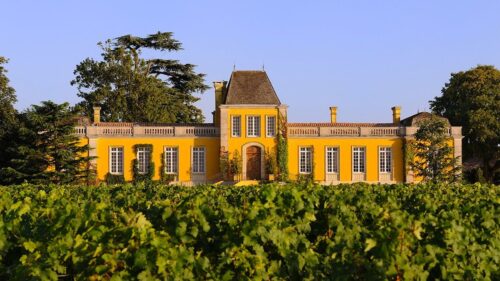
FPL : For Pédesclaux, our goal is for the wines to eventually be recognised for how much they have evolved. Since the acquisition in 2009, tremendous work has been carried out both in the vineyards and in the cellar. The wines today have nothing in common with those made before 2009, and the quality has continuously improved. I want Pédesclaux to be recognised for a level of quality that stands alongside the other great estates of Pauillac.
For Lafon-Rochet, it is slightly different. I want to rejuvenate the image of the estate and make it more approachable, while continuing to strengthen its positioning. This ambition applies to all of our properties.
GB : Could you tell us more about the 2025 vintage?
FPL : We were fortunate to avoid major vineyard issues. The 2025 vintage benefited from exceptional weather conditions, with sunshine and rainfall arriving at exactly the right moments, even if the end of the season was a little stressful. It is a beautiful vintage, the result of years of work, and we are extremely proud of it.
All our wines are organically certified, which is a real reward for our efforts. This vintage also marks a stylistic evolution, with wines that are more approachable and modern while still retaining excellent ageing potential.
GB : I really appreciate what you say about the 2025 vintage and the modernity of the wines. I do not think I have ever tasted a Lafon-Rochet as vibrant as this one. The ageing in large oak foudres and concrete vats has brought a more complete style and softened the tannins while respecting the identity of Saint-Estèphe.
FPL : Yes, we wanted that character to be more approachable in its youth, which was not necessarily the case in the past.
GB : What were the yields in 2025?
FPL : Being 100% organic, we were fortunate to achieve relatively high yields, around 40 hectolitres per hectare.
GB : Congratulations, that is an excellent yield for this vintage. I imagine Vincent Bache-Gabrielsen at Lafon-Rochet, as well as Christophe Conger at Pédesclaux and their teams, worked tirelessly.
FPL : Absolutely. They are both extremely talented individuals surrounded by strong teams. Organic farming requires a much greater presence in the vineyards. Our teams do not hesitate to work in the vines on Sundays or public holidays depending on weather conditions.
GB : The Tesseron family launched an agroforestry initiative at Lafon-Rochet. Are you continuing this approach?
FPL : Yes, because it contributes to biodiversity and improves the quality of our vineyards at Lafon-Rochet.
GB : Beyond your desire to introduce younger generations to your wines, what are your priorities in terms of commercial development?
FPL : We want to further increase awareness of our wines, have as many people as possible taste them, and welcome more visitors to our estates.
We also see room for growth in the domestic market and in the hospitality sector. New markets are opening up as well, such as India, where I travelled in November, which is very exciting. South America and Africa are also regions of interest.
Of course, we also want to strengthen our presence in markets where we are already established, such as France, the United States, Switzerland, and Asia, where we are looking to revitalise the market.
The Wines Tasted
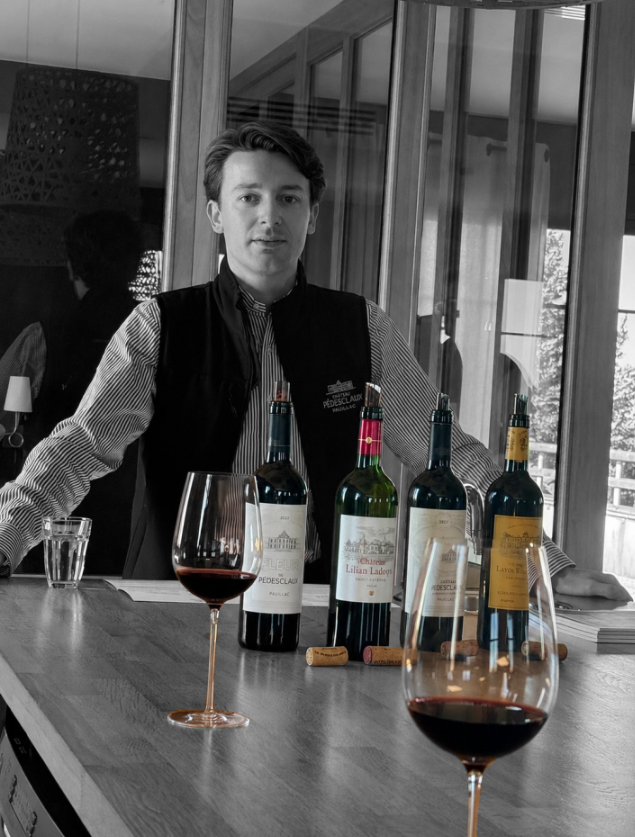
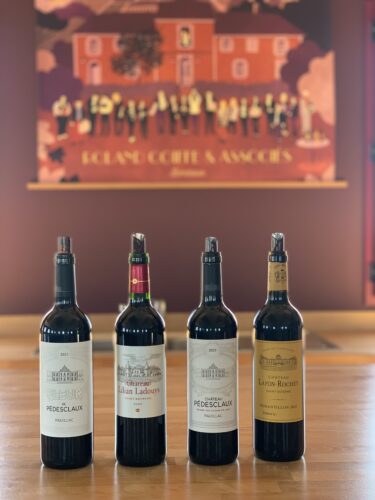
Château Lilian Ladouys, Saint Estèphe 2025 :
30% Cabernet Sauvignon, 61% Merlot, 9% Petit Verdot.
Dominated by Merlot and with a moderate alcohol level of 12.46%, this wine displays impressive aromas of ripe red and black fruits. On the palate, it is generous yet structured, finishing with a balanced and juicy character.
Château Pédesclaux, 5ème Cru Classé Pauillac 2025 :
69% Cabernet Sauvignon, 21% Merlot, 9% Cabernet Franc and 1% Petit Verdot.
The harvest was among the earliest in the history of this Fifth Growth of Pauillac. Here again, the alcohol level remains moderate at 13%, and this marks the estate’s fourth organically certified vintage.
This wine possesses the character of a true Pauillac. It is precise and well-framed, driven by velvety Cabernet Sauvignon and supported by the tannic structure one expects from Pauillac.
Château Lafon-Rochet, 4ème Cru Classé Saint Estèphe 2025 :
66% Cabernet Sauvignon, 29% Merlot, 3% Cabernet Franc and 2% Petit Verdot.
I have never tasted a Lafon-Rochet as radiant as this 2025, even though there is still a slight touch of austerity — part of the estate’s charm. It feels like a renaissance.
To better understand the reasons behind this evolution, beyond the quality of the vintage itself, I spoke with Vincent Bache-Gabrielsen, Managing Director since 2024 after spending nearly twelve years at Pédesclaux.
Vincent highlighted the estate’s exceptional 40-hectare vineyard in a single block, including old Merlot vines planted in 1938 and an average vine age of 40 years. This great terroir has always brought remarkable consistency to the wine and, particularly in warmer vintages, a balance between freshness and power. However, the wine could sometimes show a certain austerity in its youth.
To make Lafon-Rochet more charming and approachable while preserving its depth and ageing potential, three key decisions were made:
- Reducing extraction levels, an approach initiated by Frédéric Renaut, Head of Production, in 2018 and further intensified by Vincent Bache-Gabrielsen in 2025.
- Highlighting the wine’s finesse through a less marked élevage, since the objective is neither to add more tannins to an already tannic wine nor to seek additional power in Lafon-Rochet — its natural strength is already there.
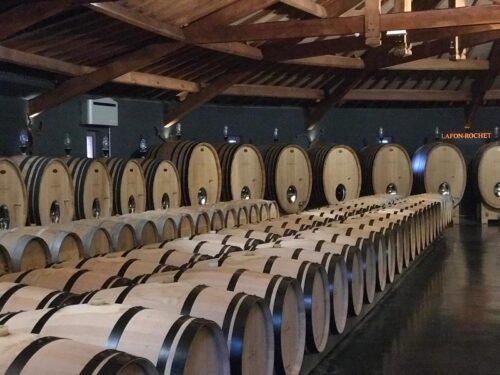
- In 2025, Vincent and his team opted for an élevage composed of 40% large oak foudres of 12 and 20 hectolitres, including seven foudres around ten years old and thirty-three new foudres with very low sulphur treatment. The remaining wine is aged 15% in new oak barrels, 35% in one- and two-year-old barrels, and 10% in concrete vats.
- Seeking an “al dente” harvest date, aiming to preserve aromatic freshness while achieving optimal phenolic ripeness.
Although mildew pressure was not an issue in 2025, Vincent believes organic farming proved highly effective that year. Thanks to the extensive work carried out on the soils at Lafon-Rochet, enriched and protected with natural composts, yields reached 41 hl/ha — well above the appellation average of 30 hl/ha.
In Summary:
- A highly successful 2025 vintage, showing excellent quality and balance
- Wines that are more approachable in their youth while retaining strong ageing potential
- A more modern, rounded and expressive style
- 100% organic: a qualitative and sustainable approach
- The Renaissance of Lafon-Rochet
- An overall ambition to create Bordeaux wines that are more immediately enjoyable without losing their identity