Today, International First Growths collaborates with nine producers across five countries: Australia, New Zealand, Chile, the United States, and Spain. In September, La Place de Bordeaux will launch its third campaign of the year, mainly focused on promoting wines from outside Bordeaux. In early July, Emma and Tom organized a large tasting featuring all the wines in their portfolio: an ideal opportunity to ask Emma a few questions.
Emma Thienpont
International First Growths
Presentation
Gerda: Can you tell me about your background and what led you to start this business?
Emma Thienpont: We should talk about both Tom’s background and mine, as we share several things in common. First of all, we are both Australian and have degrees in oenology. In Australia, I worked in production for ten years. When I arrived in Bordeaux, I took a job with a wine merchant, where I was sales manager for Australia, New Zealand, and England. Through this work, I met Tom Portet and Andrew Caillard. Tom was a buyer for Langton’s, Australia’s leading importer of fine foreign wines, and Andrew Caillard, Master of Wine, was a consultant for Langton’s. Andrew is a major supporter of our project.
In 2017, at the last Vinexpo Bordeaux, there was a lot of talk about foreign wines, especially Italian wines. We sensed that a wave was coming to La Place. Tom and I, both passionate about Australian wines, asked ourselves, “What are the Australians doing?” We thought it was a shame that no one was thinking about it, when there are bound to be suitable estates that deserve to be distributed by La Place. It was also a time when we wanted to give our careers a new boost.
Tom, who still lives in Australia, immediately began sounding out some major Australian producers to see if they would be interested. For my part, I contacted a few negociants to see if they were willing to include Australian wines in their portfolios. It wasn’t easy, as I quickly realized that there was a lack of knowledge about Australian wines in Bordeaux. But as soon as a few negociants and three estates—Jim Barry Wines, Wynns Coonawarra Estate, and Cloudburst—showed interest, everything fell into place.

G: Does the fact that you are Australian make any difference?
ET : Growing up in a country that calls itself « the lucky country » and that benefited from intense immigration throughout the 20th century has made us very open-minded. Very little shocks us, and we are always eager to find solutions. I believe that, thanks to this multicultural upbringing, Tom and I love engaging with people from all over the world and seeing that what connects us are shared values and a common vision of wine.
G : Les premières mises en marché de ces producteurs ont-elles été un succès immédiat ?
ET: There were good results from the very first year, but it was above all during the second release that everything truly came together. When a wine enters the market, all the sales teams must be trained so that they become ambassadors for the brand, able to demonstrate the same level of expertise they usually show when speaking about Bordeaux. Training the teams is essential. The advantage for foreign estates is that they can meet new customers thanks to La Place. This is also beneficial for the négociants, as it increases the number of touchpoints and conversations with a client. This is particularly important today, when the trend is toward reducing the number of suppliers rather than increasing them. Another advantage is the opportunity to meet new customers – those who are not yet loyal to Bordeaux. Fortunately, today buyers know that great wines exist everywhere and that different regions can coexist.
Five years after the creation of International First Growths, we believe that the most important thing is not just the number of cases sold, but above all the number of countries and customers we reach. As you often say, Gerda, it’s the capillarity of distribution that’s important!
G: What are the main challenges you face?
ET: The big challenge is educating wine negociants’ salespeople. If we take Australia as an example, many only know names like Penfolds and Henschke and have little knowledge of other Australian wines. During tastings, I had to start by showing them a map of Australia, because many of them didn’t know where the estates were located. We face the same challenge with wines from other countries. So, we first have to spark their interest so that the negociants are willing to listen, taste, and discover that these wines have great stories behind them. Fortunately, these salespeople are very curious.

La Place
G: What criteria do you think a domaine needs to meet in order to be successfully sold by La Place de Bordeaux?
ET: The story remains the main criterion. However, there is one exception in our portfolio: Cloudburst, a young estate founded in the 2000s, whose story stands out — but for very different reasons.
History is the domaine’s heritage. Most of the world’s great wines have always been great: they have proven themselves over 20 to 30 vintages, showing that they have great terroirs and that their wine truly has a reason to exist. We work mainly with family estates. And when you work with a family, they understand the importance of having a long-term vision. This is essential, because today, sales are not always at the same level as they were five years ago. Families know how to react with patience, continue to invest, and remain present, because they have already experienced ups and downs. They also know that the most important thing is to build a solid and lasting relationship with customers, and that takes time.
Another criterion is the people themselves. They must be open, attentive, dynamic, and understand that once a wine is sold to a customer, the work does not stop there. They must continue to invest in their brand. Finally, the wine must truly be able to stand out from the rest. And of course, its quality goes without saying.
G: What’s more, La Place de Bordeaux cannot “create” the brand. As Thomas Duroux said in one of our recent Inside articles, La Place is particularly strong at selling wines that are already in demand.
ET: Yes, but I think there is real interest among a small group of negociants with whom our marketing remains different. These negociants are not competing with twenty others offering exactly the same wine. They have a unique offering and the opportunity to build a direct partnership with the estate. When Bordeaux producers commit to wines outside Bordeaux, it requires an adapted strategy. The merchant must be prepared to talk about them, offer them, and have them tasted. Let’s not forget that producers who seek to work with La Place have already achieved a level of excellence in terms of wine quality and reputation. It is a great opportunity for Bordeaux that these producers wish to entrust the distribution of their iconic wines to négociants. In return, négociants must take this responsibility seriously. When we have a new wine in our portfolio, Tom and I always start by asking ourselves how to find the right “match.” A négociant’s strategy does not always perfectly match that of the estate, and vice versa. We have to find common ground, without forcing it. The salespeople have to believe in it, love the wine, and be motivated to share that enthusiasm with their customers. Under these conditions, we can build something together for the long term.
G: Is it difficult to convince a winery to sell its wine through La Place de Bordeaux?
ET: Yes, sometimes. There are some very fine wineries that we would love to work with, but they are not interested. They want to maintain the direct relationship they have built with their customers and do not want to lose control of their distribution.
And then, as I said, some estates are simply not suited to being sold through La Place. For example, in Australia, there are some very fine estates that only export 5% of their production. That’s too little to really make a name for themselves internationally.
G: What arguments do you put forward to convince an estate to sell its wine through La Place de Bordeaux?
ET : First of all, the opportunity to be presented alongside the greatest wines in the world, and to somehow join this “club.” This is what Bordeaux has managed to create: an absolutely incredible network of clients. It’s a fact — Bordeaux has clients that others, except perhaps the great Burgundies and the major Champagne Houses, simply do not have. The great estates that work on an exclusive basis inevitably see their distribution remain more limited. However, if we start from the principle that a fine cellar should contain all the great wines of the world, the interest for the estate is precisely to gain access to this network.
There is also a major difference compared with a Bordeaux château, which usually produces only two or three wines. Outside France, the approach is often completely different: there may be far fewer constraints on grape varieties and winemaking techniques, allowing greater creativity and the creation of numerous labels. However, it is not always relevant to distribute all of these labels in the same way. The family’s flagship wine, however, can truly stand out by being offered through La Place de Bordeaux, which provides an extraordinary distribution network.
G: So Bordeaux is the stuff of dreams.
ET: Absolutely. It’s the history of Bordeaux that attracts people, and what a privilege it is to be part of it and to be recognized by people who have the opportunity to work with the world’s greatest estates. It’s also a privilege to be included in this range: it’s a real recognition for the estate and for the quality of its wine. The Barry family, for example, loves Bordeaux. They buy en primeur every year. The fact that The Armagh Shiraz is available on La Place is a great achievement for them. When they created this cuvée in the 1980s, it was inspired by Bordeaux.
G: How do you explain the enthusiasm for foreign wines on La Place de Bordeaux?
ET: Today’s consumers are much less loyal than before. They want to discover new wines. So the arrival of foreign wines is a real opportunity to respond to this change. Even if it’s always tricky, especially when the market is struggling: there’s a tendency to point the finger at wines from outside Bordeaux. But it’s still a great opportunity for La Place, and perhaps we should broaden our horizons and talk about “La Place du Vin” instead. Bordeaux has this unique opportunity to be the supplier of the world’s greatest wines.
G: It’s also a great compliment to our system.
ET: Exactly. If a négociant’s strength lies in its logistics and distribution capacity, it’s wonderful that it can add all these other wines. This makes the work of importers easier, as they can offer their customers an even wider range from a single market. In the short term, it may seem more expensive for some importers to go through La Place, but in the long term, I am convinced that it is a system full of advantages for producers and their customers.
G: How is Bordeaux perceived in Australia?
ET: Recently, an Australian importer told me that Bordeaux is now excellent value for money. But he also pointed out that there is one concern: “Bordeaux representatives always come dressed in suits and ties.” The image that Bordeaux projects is sometimes too formal, too strict for some customers. Today, that’s no longer what they expect: just because you don’t wear a suit doesn’t mean the wine is any less good!
G: Yes, sometimes we take ourselves too seriously.
ET: Yes, and Australia’s largest importer would prefer the people at La Place to be a little more relaxed… After all, it’s only wine! It’s a product for enjoying yourself. We can organize serious tastings, but we shouldn’t take ourselves too seriously.


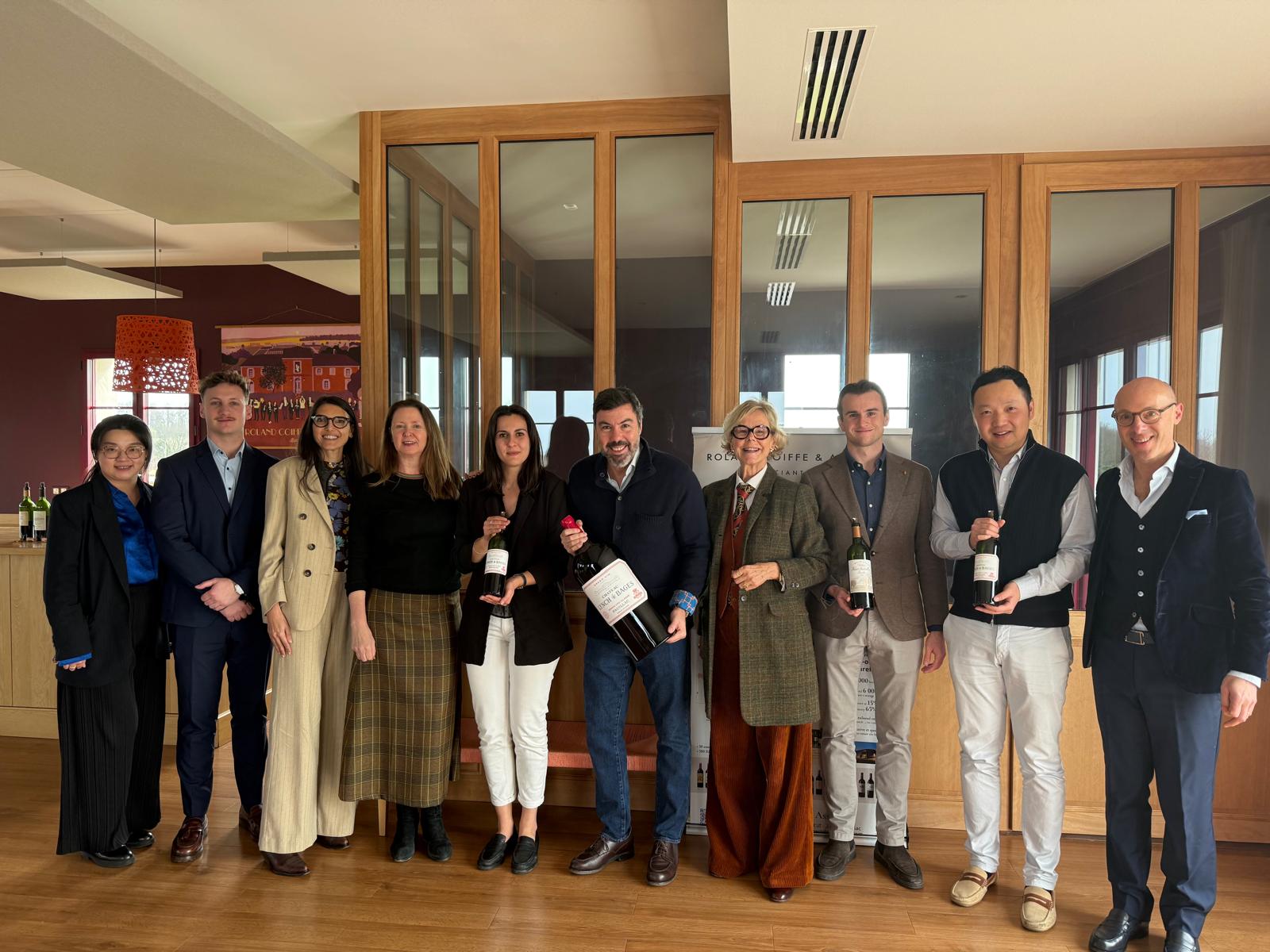
Tasting with Emma Thienpont and the RCA team, of Real de Asua and Santa Rita.
The Market
G: How do you see the wine market at the moment?
ET: The positive thing is that there are still many consumers who want to learn, take part in tastings, meet producers, and discover new wines. There is still genuine interest despite all the articles about declining consumption.
Since last year, I have noticed that the market has become more opportunistic. Sales are good, but it is sometimes difficult to understand why certain wines are selling and not those we expected. We know that all wine-producing countries are experiencing difficulties, some more than others. I have noticed that the producers we work with often have a more positive outlook than we do in Bordeaux, because they work with a wider range. Sales of more commercial wines remain stable. Everyone has seen a decline in sales of fine wines, which is often offset in part by sales of less expensive wines. Fortunately for these estates, this shows that there is still demand, which is what allows us to remain positive.
G: What do you think of the rating system today?
ET: Being well rated by several journalists is reassuring for consumers, so obviously it’s important. However, getting 100 points isn’t necessarily the best thing either. We had an example of this: the year one of our wines scored 100 points, everything sold out in a day. The following year was more difficult when the point hunters didn’t come back. It’s a shame, because it doesn’t allow us to build a stable and sustainable distribution network. What really matters is the work we do to connect estates with journalists, especially those who write “Beyond Bordeaux” reports. It’s essential that stories are told and that wines are evaluated by an impartial expert.
G:How can we attract the younger generation to wine?
ET: I am convinced that it all depends on how we present things. I’m not saying that we need to modernize everything, because even the younger generation loves tradition, but we need to find a way to communicate with them. I’m not claiming to have a miracle solution, but we mustn’t limit ourselves to social media: young people quickly move on, and the image of the vintage doesn’t stick. I believe it’s a painstaking task. In Saint-Émilion, for example, wine tourism has evolved enormously in the last 10 years. This shows that people want to come, touch, and discover in person. Many studies show that today’s consumers are looking for an experience rather than just a product. In the “New World” countries, wine tourism has been developed for much longer than in Bordeaux. Perhaps this could be a source of inspiration?

G: How do you see the upcoming September releases?
ET: Most of our customers are very cautious, especially after the 2024 Primeurs campaign. Even though I don’t think the reasons why that campaign was complicated are comparable. In September, we are releasing wines that are available for delivery, and these are also wines whose prices do not change every year. The offering is completely different, and I hope that negociants and importers will be able to see the opportunities. But we know that there is already a lot of stock on the market. The range offered by La Place has become very wide, and one wonders if there is room for everyone. That’s why it’s normal for negociants to reevaluate their portfolios for their customers. For producers, working with fewer négociants can sometimes be more effective. We know that the September campaign will not be easy. Preparation is essential. We encourage producers to provide samples to negociants so that they can then send them to their customers. It’s a huge job, but it’s essential.
G: Traders now have three campaigns: in the spring, including the Primeurs, and in September.
ET: Yes, and it’s even more difficult for importers and distributors, who receive a huge number of offers to manage. Fortunately, marketing is organized country by country. Which makes it easier for importers, who often have buyers dedicated to each market. We work with five countries: Australia, New Zealand, Chile, the United States, and Spain. There may be a new project, as it’s the right time for the estate, even though we know that the market isn’t necessarily receptive to new products—even if everything is in place: history, wine quality, committed people.
G: It may not be the best timing, but we have to stay focused on our roadmap. There are opportunities in every market, and we have to remain dynamic.
ET: Yes, and we also have to share this positive spirit. The problem with Bordeaux is that we hear the same thing too often: “Things are bad, things are bad,” and that’s what customers remember. I love working with foreigners because they have a different and often more optimistic perspective. Of course, they also have their challenges and are very connected to the market, but they remain dynamic. And there will always be room for well-targeted offers.