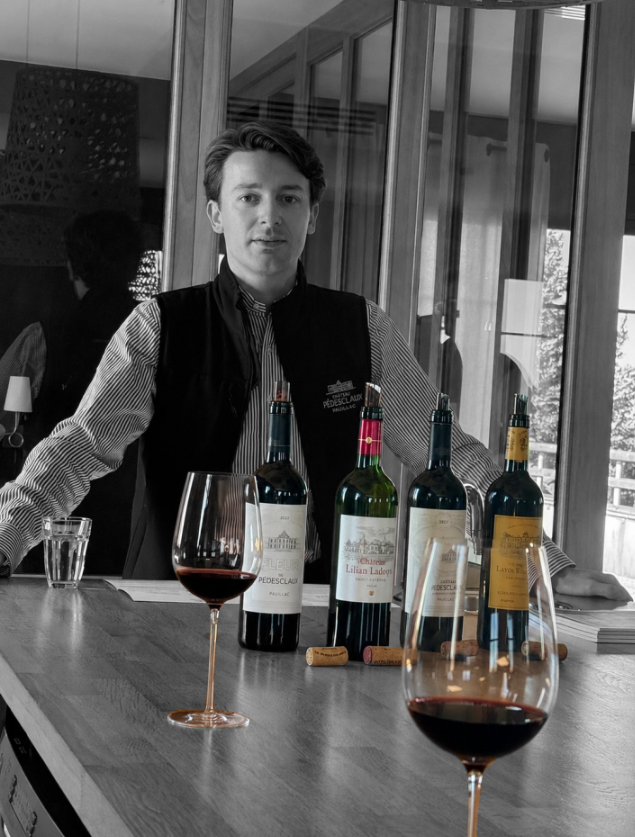
Julien Viaud
Agronomist & Oenologist – Partner at Rolland & Associates Laboratory
Introduction
Gerda Beziade : What are the main challenges you face?
Julien Viaud : There are several. Climate change forces us to abandon fixed plans and instead stay closely connected to the vineyard and the cellar, working with even greater precision day by day.
Another challenge we all share is commercialization, which is deeply tied to these technical challenges.
I truly believe that today, there are good wines being made all over the world. To remain desired — and desirable — we must work harder than others and aim for ever greater precision. We can no longer rely solely on the name “Bordeaux” or on our exceptional terroirs. We need to be creative, reactive, and attentive to what consumers want.
It is essential to understand today’s consumer: they want wine that is good, clean, and transparent. They no longer find their way easily through the proliferation of labels — organic, biodynamic, sustainable, Ecocert… What they want is clarity: to know what’s in the wine, to trust the ethics behind its production, and ultimately, to find pleasure in drinking it.
In short, we must take environmental responsibility, be fully transparent with the consumer, and, of course, produce excellent wines.
I see these three commitments as our three biggest challenges. We face fierce competition on a global scale, and many winegrowers today are technically outstanding. Bordeaux still has the advantage of producing wines that are naturally balanced — which isn’t always the case elsewhere — but even in our stronghold, terroir-driven wines, the competition is now very real.

GB : How many estates do you consult for, and in how many countries?
JV : The lab works with about 300 estates across 18 countries. Personally, I work with 60 estates in 8 of those countries.
GB : Outside of Bordeaux, which wine region or country has your heart?
JV : Italy — because I’m half Italian. But it’s not just about my roots; I love working there because Italians move fast. They’re inspiring, agile, and they make truly great wines — which certainly doesn’t hurt!
GB : And of course, they are among the greatest merchants in the world…
JV : Yes, and they benefit from the fact that, wherever you go in the world, you can find Italian restaurants — always serving Italian wines, at every level.

Terroirs et Vines
GB : In Europe especially, climate change is at the center of discussions. Should Bordeaux allow new grape varieties?
JV : No. I think that would be a very bad idea — we would lose our identity. First, we need to look to the past. In the 1970s, quality was often catastrophic, and in the 1980s, it was on average only fair — with a few exceptions like 1982 and 1989. We then realized that with warmer vintages, which gave riper grapes, we could produce much better wines — as in 1989, 1990, 1996, or 2000. This was thanks to dynamic winegrowers, particularly on the Right Bank, like Jean-Luc Thunevin and the “garagistes.” The dials were pushed the other way: green harvesting, higher trellising, lower yields. This allowed us to achieve beautiful ripeness.
Of course, there were excesses — overly marked oak, exaggerated concentration — but we learned what true ripeness meant. And when you taste some 2000 or 2001 vintages today, I find complexity, balance, freshness, and plenty to challenge preconceived ideas!
Bordeaux can absolutely produce great wines without introducing new grape varieties. The real revolution today is happening in the vineyard. We have an incredible diversity of plant material before we even think of planting new grapes. There are viticultural tools still underused. We’ve already had our oenological revolution, with controlled fermentations and temperature management in the cellar. Today, while fine-tuning élevage remains important, the real future of Bordeaux will be shaped in the vineyard.
GB : In this viticultural revolution, is organic farming a must for a grand cru?
JV : No. But organics have pushed us to be more precise in vineyard management. When you farm organically, there’s no room for error — you cannot use curative products. If mildew hits, you risk losing the crop. This has forced us to anticipate more, especially weather conditions, and follow the vineyard step by step, day by day — something that wasn’t always done everywhere.
That said, even in conventional viticulture, we can no longer use the harsh, corrosive products that were allowed 20 years ago. Even conventional growers no longer have room for error.
The real challenge with organic and biodynamic farming is profitability: you need strong financial resources to handle it, because you can lose one harvest out of five. Not everyone can take that risk. You must also be able to sell those wines at higher prices to ensure the economic viability of the estate.
GB : A great Saint-Émilion cru recently committed to agroecology, a movement that seeks to boost the natural fertility of the soil by replicating nature’s cycles. What’s your view?
JV : I started my career on a tractor — so when I see trees planted right in the middle of vineyard rows, my first thought is how much of a headache that must be for vineyard work!
That said, I absolutely recognize that redefining vineyard landscapes is essential. We’ve seen it happen elsewhere — in the Languedoc, for example. Breaking monoculture by recreating an ecosystem — clearing spaces, introducing plant species that provide shade, reduce sunlight, and bring life back to the soil — is vital.
I’m not entirely convinced that just planting a few trees among the vines is enough, but I fully agree that we need pioneers to test, experiment, and push boundaries.
Personally, I believe more in a complete rethinking of vineyard landscapes: planting hedgerows to break the wind, shelter insects, provide shade… Of course, this sometimes means pulling out vines. But we must decide what we want: to remain locked in a monoculture of grapes, or to think of the estate as a full-fledged ecosystem.

The Present and Future of Distribution
GB : How do you see the current state of the market?
JV : Every time there’s a geopolitical or economic crisis — the Gulf War in the early 90s, the subprime crisis in 2008 — Bordeaux ends up vulnerable. Perhaps the wine trade hasn’t questioned enough how its wines are actually distributed.
I travel five months out of the year, and I see what’s happening elsewhere. When everything is going well, no one asks themselves the right questions: How is my wine being distributed? How is it being consumed? Today, we see that Bordeaux’s biggest stars are being consumed less and less. In London, I’ve met American collectors with spectacular cellars overflowing with Bordeaux grands crus — but are they actually being drunk? Bordeaux has filled the world’s cellars without always being consumed, which has likely contributed to the market being blocked.
Global wine consumption has fallen, but not dramatically. That’s not why we’ve gone from decent en primeur campaigns to disastrous ones. Others are doing well: look at Gérard Bertrand in France, or many Italian producers who are fighting hard and successfully selling their wines. Distribution models are changing, and Bordeaux has no choice but to adapt.
Is it still relevant that a château’s grand vin is sold by 50 négociants on the Place de Bordeaux? When one of them dumps its stocks at low prices, it destabilizes the entire market — and with today’s transparent information flow, everyone finds out immediately. This damages brand image and devalues the stock held by others. The system needs to be rethought: estates must get closer to their importers and distributors and do more to protect négociants’ margins. Being a négociant is a tough job — they have to know the wines and be active in the field against competitors. Maybe until now, things were too easy, and not enough effort was made. But things are changing. Estates are also getting closer to the final consumer, and that’s essential. The Place remains an extraordinary machine for global distribution — but it must evolve.
Excessive price volatility has also destabilized the market. Who can understand 30–50% price differences between two vintages? The end consumer, on the other side of the world, is buying a brand — from the Right Bank, the Left Bank, maybe a grape variety — but not a specific vintage. It’s up to us to guarantee the wine’s quality, year in and year out. That’s part of my job: one year, only 30% of the harvest makes it into the grand vin; another year, 80%, because the vintage is exceptional. When I buy a vintage Champagne, I don’t focus on the year — I trust the brand and the producer’s know-how. The market is asking for stable brands, with little price fluctuation. In my view, that’s one of the keys to overcoming the current crisis.
GB : Thomas Duroux once said: “In Bordeaux, we probably suffer from a lack of strong brands. They exist, but too few compared to other regions.”
JV : That’s true. We have a few major players, often positioned at the entry level. But Bordeaux is a region of range and diversity. At every price point, we know how to produce ultra-competitive wines. Price is not the real issue: between €20 and €50, classified growths offer exceptional pleasure. In appellations like Fronsac, Castillon, the satellites of Saint-Émilion, Moulis, Blaye — around €12–15 — you can find gems. But yes, Bordeaux lacks strong brands capable of shining a light on the entire region internationally.
GB : So there is still a future for small châteaux in Bordeaux?
JV : Absolutely. Bordeaux has many dynamic small estates, but you need to take the time to discover them. To have a presence on the Place, they must find négociant partners who believe in them, and they must be able to produce enough volume — 50,000 to 100,000 bottles — to make distribution viable for both sides. And, of course, you must make good wine — that’s the basic requirement. But you also need to build a brand, because let’s be honest: who in the world has heard of Castillon or Blaye?
The problem is that classified growths are available at the same price as very good Côtes de Castillon or Fronsac — sometimes better ones. Bordeaux has this “glass ceiling” that you don’t find elsewhere: if a château in Castillon sells its wine at €15, immediately someone will say, “at that price, I can get a Saint-Émilion Grand Cru.” In Languedoc, I produce cuvées at €10–15 and others at €50, regardless of the appellation, and they sell.
GB : So Bordeaux is a victim of its own classification?
JV : Not entirely, because the classification system has also brought a lot to the region. They were once a guarantee of quality — but today, some are out of step with market expectations.
Some classifications are hard for consumers to read, and they no longer drive quality standards as they once did. Consumers looking for a clear promise of pleasure, taste, and experience get lost. The message has become muddled.
GB : Do you think this system will ever change?
JV : No, I don’t think so — it’s too political. But the crisis itself will inevitably act as a regulator. Today, vines are being pulled out on a massive scale. The social impact is huge, but it’s necessary. We forget that wine is not an essential product — people drink it for pleasure. We should cultivate fewer hectares, but grow more grapes per hectare to remain profitable while still producing good, pleasurable wines.
Perhaps we also need to be more aggressive with marketing, like the spirits industry. Look at Prosecco in Italy: millions of liters sold, with the Spritz as the driving force. Young people are drawn to novelty, dynamism, creativity. They want to be seduced by a modern approach. The problem isn’t the alcohol — the younger generation often simply finds that wine isn’t “fun” enough.
Bordeaux offers incredible diversity: it produces affordable wines and classified growths made for aging — because I truly believe nothing compares to a great wine after 15 years. Nature sets the pace, but we must communicate this better. Young people don’t only drink fresh, fruity “glouglou” wines. I don’t see why they wouldn’t enjoy a mature wine — as long as it’s served without fuss or pretension.
Other regions are also producing excellent wines, with attractive packaging and more aggressive communication. Generation Z has no problem picking a wine from Chile or elsewhere. Bordeaux must keep improving on all fronts — and accept that not everyone can be saved.
GB : Does Bordeaux have more problems than other regions?
JV : No, I don’t think so. But we’ve fallen harder than some others, for the reasons I mentioned. Maybe we’re also more anxious, more lost about which model to follow. It seems crucial to me that we keep analyzing our market: consumers love a label because it represents a style they enjoy. Take Tertre Roteboeuf: its identity is a rich, exuberant, generous wine. If tomorrow the Mitjaville family completely changed its style, the clients would stop buying — because it wouldn’t be Tertre Roteboeuf anymore. Every wine must stay true to its personality, its market, and its customers.
GB : What do you think of today’s wine rating system?
JV : It has changed a lot. Scores still matter, but they no longer play the central role they did under Robert Parker, who was undoubtedly the master. Today, ratings are a commercial tool: a salesperson can say “this wine has 96 points,” which makes selling easier. But there is no longer a single dominant voice. We still have influential critics like James Suckling, Wine Spectator, Wine Enthusiast, or Decanter. But I don’t think a négociant buys a wine solely based on its score.
Michel Rolland has often been caricatured, pigeonholed into a single style — but he made wines that met market demand, and he made them very well. If the market wanted a different style, he could do that too. Our job as consultants is to guide estates according to their identity and market expectations — not to make wines simply to please ourselves. If you make a wine first and think about the market later, you lose ten years. You have to approach it the right way, with perspective. That is one of the great responsibilities of our work, and I hope to rise to it thanks to our international experience — which is a real strength.

Conclusion
GB : Do you have a wine that has marked your life?
JV : Yes — Château Latour. I did my oenology internship there, and it was where I was first given a chance in this beautiful profession. The director, Frédéric Engerer, opened the doors of the cellar for me and allowed me to discover everything. I also remember a dinner to which I was, of course, not invited — but the cellar master let me taste the 1996 Latour. That gesture deeply moved me: to give a young intern like me the chance to taste a wine one rarely encounters was truly unforgettable.
GB : To end on a positive note about Bordeaux?
JV : Today, we must not simply be optimistic and sit back, thinking everything will sort itself out. That would be a mistake! We have all the tools we need to get through this very difficult period. We produce beautifully balanced wines that the world envies. Bordeaux makes eyes sparkle! We have Ferraris — and we are learning to drive them better and better.
In times of crisis, we must stay the course and move forward strategically. I am certain of it. We will come out of this stronger. But we must be hyper-professional, meticulous. Bordeaux is a true beacon for the world, with magnificent wines at unbeatable prices. It’s time to put them back in the spotlight.