Thibault Chaperon
Managing Director of the Caisserie Bordelaise Group
Frédéric Argagnon
Sales Manager
Nine producers, mainly from the Gironde, representing 90% of French production in this sector, have come together within the Alliance France Caisse Bois (AFCB) association. Their objective is to obtain “a little recognition” and to “put the wooden body, as well as its assets and qualities, back at the heart of the discussions”. So I asked a few questions to Thibault Chaperon, Vice-President of the AFCB and General Manager of the Caisserie Bordelaise group, which will allow you to better understand how the Caisserie is facing the challenges of the current market, what its adaptation strategies are, and what prospects it sees for the future.
The Alliance France Caisse Bois

Gerda: Why did you create the Alliance France Caisse Bois?
Thibault Chaperon: In order to federate and communicate together. We are committed to bringing our sector to the light of day, to show that wood is a virtuous, natural product, which is part of a cycle but which cannot be recycled, at least not yet. We want to go further in the regulatory framework, by getting closer to local authorities, the State and the CIVB, which still favour cardboard, in order to change the way people look at wooden crates. We must defend our product, which is part of a historical, traditional and artisanal sector. It has its place and its reason for being. We are part of the wine industry, which is one of the jewels of France. It must be protected, and we have our role to play in this area.
Presentation
G: What are the main challenges you are facing at the moment?
TC: Our main challenge is to explain our product, which remains very traditional and artisanal. We need to inform about the production process, especially taking into account the ecological concerns of our customers, such as châteaux and merchants. There are many untruths about our products, so we need to value our know-how and show the eco-friendly aspect of our wooden crates. In the wine sector, two types of packaging dominate: cardboard, which represents 98% of the market, and wooden crates, only 2%. We want to spread the word about the sustainable side of the wooden crate. It is a product made from renewable raw materials, since mature trees from sustainably managed forests are used. Each tree cut down is replaced by a new one, and we are certified by the European Forest Management Programme (PEFC). Unlike cardboard, for which paper pulp is used, the wooden crate is less energy-intensive and more environmentally friendly.
G: Do you only use pine trees that are more than 50 years old?
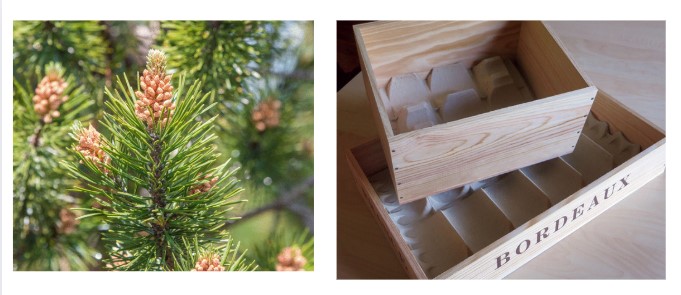
TC: The majority of the pins we use are actually more than 50 years old, because we need pins of a certain diameter to make the crates. We harvest trees at the end of their life to preserve the forest and allow the regeneration of new pines that will capture carbon. We only use renewable wood from the forests of the Landes, Spain and Portugal.
Production & Supply
G: Is it always cheaper to import Spanish wood?
TC: The price gap still exists, especially for more complex productions. In France, the large sawmills have not invested in the niche of wooden crates, unlike in Spain, where sawmills are very reactive and send 6 to 7 trucks per week.
G: Does transport also have an impact on the carbon footprint?
TC: That’s true, but in each truck we carry up to 30,000 box kits, which optimizes transport. In France, the calculation of the carbon footprint does not include carbon capture by wood; And we remain on a very energy-efficient product. The wooden box has many advantages: it provides safety during transport, offers protection against light and possible variations in temperature and humidity. We have seen some Grands Crus go to cardboard, saying that it is more ecological, which is not entirely true. Cardboard is often thrown away, especially in countries that are not yet suitable for recycling. If you want a high-end cardboard, it cannot be recycled because it contains chemicals.
Environmental Perspective
G: How do you communicate the ecological aspect of your products?
TC: The wooden box consumes less water and does not require food resources such as starch, which are necessary for cardboard. Paper pulp is not necessarily produced in France. These are elements that must be taken into account. Unlike cardboard, only part of which is recycled, our crates can be recovered and reused. For the opening of the opera season, as patrons, we placed 1500 boxes on the square in front of the theatre to make seats. At the beginning, the town hall told us: “How are we going to get them back?” I replied: “You’ll see, in a minute, everyone will take their box and take it home. Who hasn’t picked up a crate to use as storage? A few years ago, a survey showed that about 35% of wooden crates are reused. This is called revaluation. We want to put forward the idea of recyclable in parallel with that of recoverability.
Market Challenges
G: So your main challenge is communication in the face of CSR requirements?
TC: Yes, it is an important issue. In addition, it is essential to follow our historical customers while innovating to offer them new products, unique markings, and economical solutions despite cost increases. We had to increase our prices by 45%, following the post-covid period, but we now offer thinner crates to lighten the financial burden.
Innovation & Future Prospects
G: Are you working on new products? For example, the traditional Bordeaux cash register, which is nailed, is difficult to open.
TC: Yes, we offer several opening options, but sturdiness is important to protect the bottles. We worked on more than 2,500 different formats, because each castle wants to personalise its case, with choices of wood, marking, and even engravings. However, prices can rise quickly for specific orders, and this sometimes limits our ability to add value.
G: According to the AFCB, the sector’s turnover is down by 20%. What are your forecasts?
TC: We are closely linked to the wine market and hope for a recovery. We also work with customers to offer them new products and support them as much as possible in their project development despite an unfavorable economic context. Our company is 100 years old, and we remain confident despite the current crisis, because a niche market can bounce back quickly.

Gerda BEZIADE has an incredible passion for wine, and has a perfect knowledge of Bordeaux acquired in prestigious wine merchants for 25 years. Gerda joins Roland Coiffe & Associés to bring you more information about the properties we market with “Inside La PLACE“.