Stéphanie de Boüard-Rivoal
Co-owner and Managing Director
Introduction

GB : You’re at the head of a major enterprise — 130 hectares, three restaurants, 170 employees. How do you handle that level of responsibility on a daily basis?
SBR : You have to keep things in perspective, but in the world of wine, it’s certainly a significant structure, and managing the teams is particularly stimulating. We’ve grown from 25 to 170 employees, and from 30 to 130 hectares in just over ten years. That’s considerable growth — one that had to be guided and supported. It requires stepping back and keeping an overall perspective to manage everything with a well-thought-out and clearly communicated strategy. It also demands method and rigor.
We’ve established departments that work closely together — both within the vineyard and alongside our restaurants and hotels. Some functions, such as communications and accounting, are transversal.
I’m fortunate to rely on a strong team, with department heads I meet every week. We communicate as often as needed, but these regular meetings help ensure that the framework and direction I’ve set remain clear. The vision I carry must be understood and shared in order to be implemented effectively.
I often ask myself, when something goes off track: “Was I clear enough?” That question is essential, because communication is the key. Everyone must understand the vision, embrace it, and feel fully part of the project.
So when I travel — which happens very often — I can do so with peace of mind. I know everything is in good hands, that I can rely on capable and trustworthy colleagues who are fully aligned with my standards and expectations for the estate.

The brand Building
GB : Among all your strategic decisions, which one has had the biggest impact on you and made you the proudest?
SBR : Among all my strategic decisions, I believe I’m particularly proud of the ones I made for Carillon. Originally, Carillon was the second wine — and often, the second wine is seen as the “default” wine. That bothered me. I found this label limiting compared to the potential I saw in Carillon.
So, I set myself the mission of transforming Carillon d’Angélus — to make it evolve and give it a true identity. Between 2016 and 2019, we began a new era: with vineyards 100% dedicated to Carillon, acquired across the Saint-Émilion appellation, Carillon became independent from its elder sibling. These vines come from prestigious areas — Figeac–Cheval Blanc, Saint-Christophe-des-Bardes, and the outskirts of Angélus — offering three types of soils and terroirs, a true mosaic of Saint-Émilion.
Today, Carillon has its own identity, its own style: a crisp, clean attack, a full and elegant mid-palate, and a fresh, delicate, lingering finish. We gave ourselves the means to fully realize this ambition with the construction of the Carillon cellar — a spectacular investment in scale, architecture, and its gravity-flow design.
I’m proud to have led this transformation — to have helped Carillon step out of the shadows and become a major wine in its own right, crafted with the same care and precision as Angélus. It’s a small revolution, a success that, in my view, has changed the perception of this wine — and, more broadly, of the wine world itself.
GB : Is it important to have a brand like Carillon d’Angélus as part of everything you do — for brand building and image — beyond, of course, the quality of the wine itself?
SBR : You’re right — quality always comes first. It’s the driving force, even before anything else is imagined. That said, the world of wine is evolving rapidly, and in recent years it has clearly shifted toward an environment defined by strong brands.
This wasn’t a premeditated strategy on our part; it’s more a natural consequence of our pursuit of excellence. The name Angélus — that of the grand vin — shines brightly, but this reputation, both fragile and precious, must be built and protected every single day.
Today, Angélus represents an entire galaxy, where alongside the grand vin orbit Carillon d’Angélus, Numéro 3 d’Angélus, Tempo d’Angélus, and Hommage à Élisabeth Bouchet. Consumers need trust and clear reference points — whether they are from the new generation, perhaps even more sensitive to this, or long-time enthusiasts who already know us. These brands, both strong and coherent, are essential in guiding them.
A wine that is recognized — with a distinctive label, thoughtful design, elegant packaging, and presentation — that matters. Consumers perceive these wines as expressions of the same family — an umbrella brand, Angélus, with a structured, coherent, and easily identifiable universe. All of this serves as a guarantee of trust and quality.

The challenges of the Bordeaux market and the Place de Bordeaux
GB : How do you see the current state of the fine wine market in Bordeaux?
SBR : It’s a market currently going through a period of crisis — one that needs to reinvent and renew itself, especially around the en primeur campaigns. Preparation and anticipation are now essential: we must know our clients, go out to meet them, be present in the markets, talk about Bordeaux, talk about our wines. Because there is savoir-faire, but as Paul Bocuse used to say, there’s also faire-savoir — the art of making it known. And in times of crisis, it’s more important than ever to show, to make people discover or rediscover our wines, and to educate and inspire — particularly among the younger generations.
This educational mission is absolutely essential. Through the tastings we organize in wine clubs, business schools, and universities, we aim to prevent a generational disconnect in wine culture. People often say young consumers are turning away from wine — it’s our role to ensure this transfer of knowledge, of taste, and of culture.
We must also stand up — or at least remain vigilant — so that the discourse of health lobbies and anti-wine activists doesn’t dominate. We must remind people that wine cannot be equated with alcohol in the simplistic way they portray it. Of course, there is alcohol in wine, but wine cannot be reduced to alcohol alone, nor compared to pornography or tobacco. It’s essential to say this, to communicate it clearly. I often quote Pasteur, who said that “wine is the most healthful and hygienic of beverages.” Louis Pasteur, a chemist by training, knew exactly what he was talking about. And I’ve seen it in my own family — my grandparents lived to 96 and 97 years old, and they shared a bottle of wine every day for nearly 75 years.
So yes, we have a major mission of education, communication, and advocacy ahead of us. That includes using social media. We must multiply the channels and platforms to share our passion, to fight against misconceptions and caricatures. It’s a subject I feel very strongly about.
GB : Bernard Burtschy recently said that major brands are trying to regain control over their distribution. Do you agree with him, or do you still believe in the Place de Bordeaux system?
SBR : I can only observe — and regret — that the Place de Bordeaux has weakened and now needs, as I mentioned earlier, to reinvent itself. For the moment, I don’t know of a more efficient system than the Place, which still has many strengths — as proven by the growing interest of major international producers in recent years. That said, I believe a deep, honest, and rigorous reflection is needed — particularly regarding the en primeur system — and that reflection must be collective.
Perhaps there are too many players, too many négociants, too many wines released to the market. Certain behaviors — such as some négociants not respecting price guidelines — weaken the entire chain. It creates imbalance and a negative spiral that drags the whole system downward.
Better control over one’s distribution is certainly one possible path. But the Place de Bordeaux has a long history and a proven model. Even if it’s showing signs of fatigue today, I don’t believe we should dismantle such an extraordinarily efficient tool. Instead, we must work with the Place to find solutions that ensure qualitative distribution and an economically sustainable model for everyone. However, each estate has its own identity and business model, and the Place, by nature, offers a generic framework that doesn’t always take these specificities sufficiently into account.
At present, I find the situation worrying: the sector is weakening, and collective, non-partisan action has become an urgent necessity. On our end, we plan to act on our distribution in the coming months to make it more qualitative. If it is, it will better serve those partners who work seriously — many of whom have been penalized by the instability caused by less scrupulous players. Certain behaviors have a lasting negative impact on the entire community that is the Place.
GB : Do you think there’s still a future for the en primeur system? People increasingly live in cities without cellars, and the younger generation doesn’t like to wait before consuming.
SBR : I do believe there’s still a future — but only if Bordeaux succeeds in restoring the prestige of the en primeur system, and not just through a few isolated successes, such as perhaps Angélus in 2024. Bordeaux as a whole must become attractive again during en primeur. The younger generation, in particular, tends to be impatient and doesn’t want to buy wines to drink decades later. But if they understand that by buying now they’re making a smart purchase, they can be persuaded.
Of course, that requires trust. If the message is unclear, trust will be hard to build. That’s why Bordeaux as a whole must make smart, deliberate choices. And price is not the only factor. We saw it clearly in 2024: prices were very attractive, but demand overall did not follow. The market environment was difficult, the geopolitical context uncertain, and the vintage unfairly criticized by parts of the press — none of which helped promote 2024.
We now have a real opportunity with 2025 to bounce back. It could be a breath of fresh air — but if 2026 turns out to be more difficult, the relapse could be harsh.
We must therefore be very cautious. It’s normal for 2025 prices to rise somewhat — but this increase must be measured and controlled, so as not to break the fragile market dynamic or lose the trust of consumers. Collectively, we have a chance to chart a more positive and inspiring trajectory for the next campaign. We absolutely must not miss it. It may not save the en primeur system entirely, but it could help move it in the right direction.

Distribution: today and tomorrow
GB : Because of these strong price fluctuations, consumers are getting lost too.
SBR : Yes, I don’t think that’s a good thing. I’ve always believed it’s better to be more consistent, more stable. Not everyone agrees — some think it’s wonderful to be able to go very high, very fast… I’m not so sure. Consumer habits have changed a lot, and I don’t think today’s clients are willing to pay much more for a vintage, even an exceptional one.
Above all, when prices drop sharply, it damages the brand and worries consumers. It creates a negative expectation — “how low will it go?” Conversely, when prices rise, it can build confidence, yes — but we mustn’t go too far either. When the declines are too steep, they send a signal of anxiety to the market, which then goes into a holding pattern.
I believe it would be beneficial for the entire Place de Bordeaux if price variations were more moderate and better controlled.
GB : But are we really managing to work together?
SBR : Once you know your distribution network well — I mean the first circle — and there’s good communication and transparency in the exchanges, then yes, we can. Négociants need to inform us precisely about the markets where they sell our wines, and in return, we must share our intentions: to strengthen some markets or, on the contrary, to avoid being overly present in others.
I think we’ve made great progress on this point. There’s a real relationship of trust — but it needs to be renewed every year. As long as the négociant is satisfied with their sales and the estate is as well, the relationship remains balanced. It’s a mutual relationship, one that must be valued and reassessed annually as the market evolves.
GB : Speaking of markets, I saw in the statistics you sent us that Europe and Asia are very important for you?
SBR : Yes, Europe currently represents around 50% of our sales. As for Asia, the situation has been mixed: China has seen a significant slowdown, but other Asian markets — Japan, Singapore, the Philippines, Malaysia, Thailand, Korea, and Taiwan — are performing remarkably well. Cambodia too, where we have a strong presence, even though the current context there is more complex. Asia remains a major strategic focus.
At the same time, we’re seeing strong progress in the United States. Despite a challenging environment and trade tariffs, we’re building our presence methodically: three team members are dedicated to the U.S. market — Victoire carries out field missions there, while two others are based locally. I had noticed that our wines were somewhat underrepresented there, and we’re now beginning to close that gap.
In Asia, we have a representative based in China, while Bong, based in Bordeaux, oversees the rest of the region. In Europe, two team members focus specifically on France, and Anna manages the entire continent. Every market is covered so that our wines are represented in the best possible way — we want to stay close to our distributors and our consumers.
GB : Those are major investments for 130 hectares of vines.
SBR : Yes, but I believe our strength lies precisely in being on the ground, speaking about our wines. The estate has a very human dimension, and we must continue to ensure that people keep those touchpoints alive — that they taste our wines, stay informed about our developments and projects. Many come to visit the estate, but I think it’s just as important for us to go to them. It moves them; they appreciate that personal attention — and above all, it immerses them in the world of Angélus.
GB : You have to hold your place.
SBR : Absolutely. It’s key right now. With social media, everything moves so fast.

Conclusion
GB : Can you tell us a few words about the 2025 vintage?
SBR : You’re the first — the first négociant — to whom I’m revealing the name: L’Irrésistible. The name had to reflect the character of the vintage while carrying a certain resonance. Translation never quite conveys its full meaning.
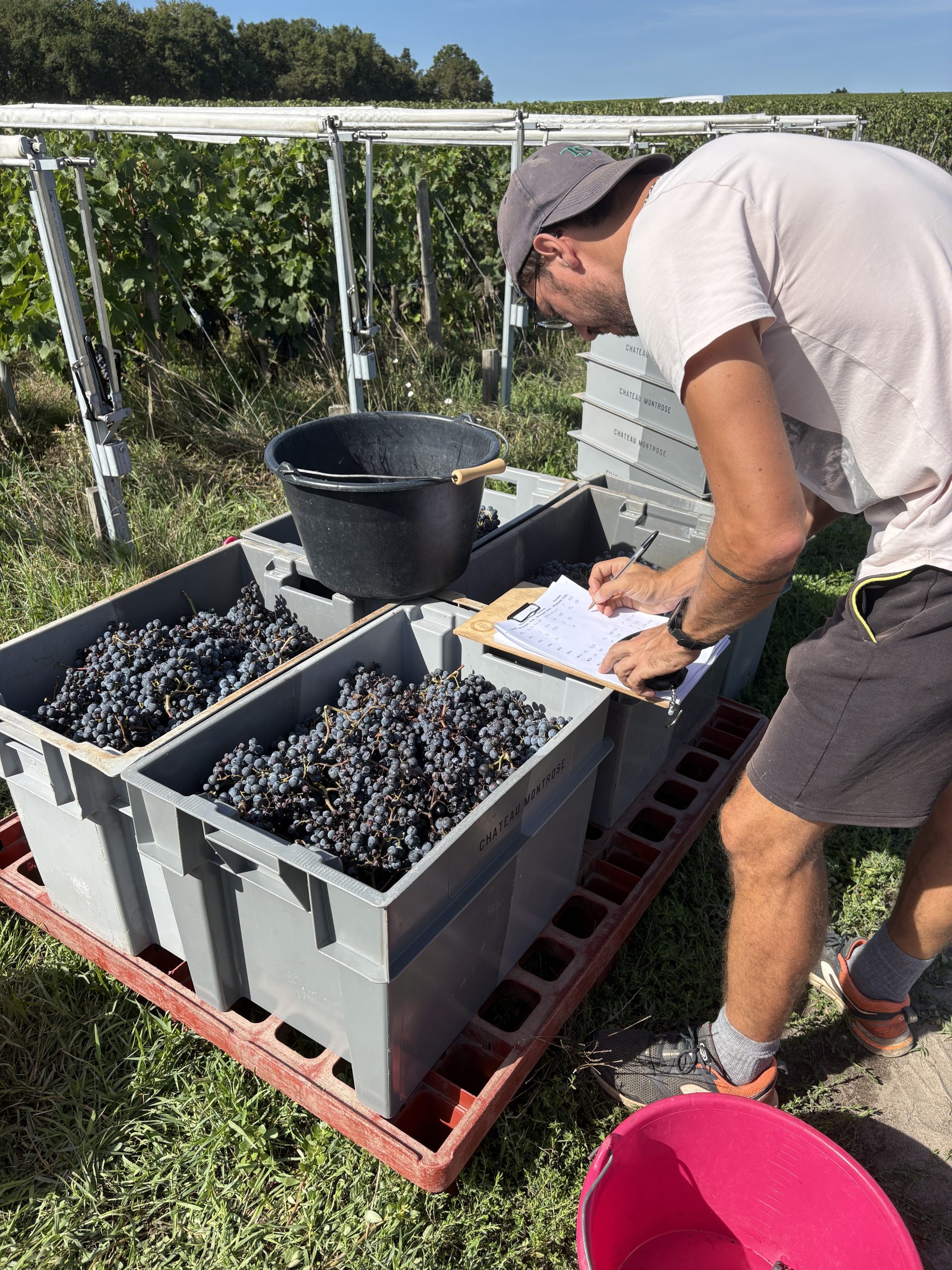
We harvested over a relatively short period — barely ten days. The Merlots reached maturity almost simultaneously across some twenty hectares, very quickly. The Cabernets were picked a little later, but still within a tight window. Although this vintage differs from 2022, the Cabernet Francs once again showed remarkable resilience and strength, aided by surface cover crops that preserved freshness and moisture. The grapes reached perfect ripeness, with beautifully thick skins.
We benefited from a very sunny, dry summer, yet the vines never suffered: the deep clay and limestone soils retained enough water and minerals despite the drought. We observed virtually no scorching or shriveling, except slightly on the youngest vines, and density sorting allowed us to select an exceptional harvest.
Yields are not high, but they remain perfectly respectable given the conditions — around 35 hectoliters per hectare. In short, the 2025 vintage is precise, concentrated, and full of promise — perfectly aligned with the high standards that guide our estate.
GB : Can you tell me a few words about the construction of the new cellar at Angélus?
SBR : The cellar is still under construction. It should be completed during 2026, which will likely be the first vintage produced in this new space. It’s a rather revolutionary cellar, truly unique in its design: everything is suspended. Only three materials have been used — wood, stainless steel, and concrete — in a remarkable architectural feat. Across a vast surface, there are no beams, no girders, no supporting pillars. The structure is inspired by cathedral architecture, with a thick floor supporting the vaulted ceiling above. It will be unveiled in 2026 — an extraordinary and truly spectacular creation.
GB : You left the Saint-Émilion classification. How do you feel about that, three years later?
SBR : A great sense of freedom. We’ve never been as demanding or as precise about the quality of our wines as we are now. But stepping away has allowed us to focus entirely on the essence — on crafting the wines themselves — without the distractions of rivalry, jealousy, or criticism. I’m convinced the market has fully understood and accepted this. I’m genuinely happy that we now have this freedom for Angélus.