“I could not have predicted that someday there would be advertising using wine as a harmful substance.”
Dr Laura Catena
4th generation vintner and author
Retired emergency physician
Founder of Catena Institute of Wine
Presentation
Gerda Beziade: What are the biggest challenges you face in your day-to-day work? n ?
Laura Catena: The most important challenge is to balance the essential long-term projects with the short-term needs that seem so urgent. For example, soil studies that allow us to elevate the quality of our wines to make terroir-specific wines; more elegant, more beautiful, age-worthy wines.
Another example of a long-term project is the work that led to the discovery of the 1.4-hectare Mundus parcel in the Adrianna Vineyard, or the work I am doing through my website In Defense of Wine to explain all the accurate science around alcohol in moderation and health so that wine in moderation can be part of a healthy lifestyle.
So yes, the greatest challenge for me is to balance the long-term needs that are so important with the short-term needs that are time-sensitive.
And, as you know, I’m an emergency physician, and it’s quite similar in the emergency department where you must prioritize very ill people, despite having all kinds of patients with less serious problems who also need assistance, and in the end you need to make sure everybody is being taken care of.

G : You are the 4th generation of vintner at Catena Zapata. Have there been any challenges you hadn’t anticipated? Perhaps Mother Nature becoming increasingly unpredictable?
LC : For sure climate change is something that I had not at all anticipated. At high altitude in Mendoza we are not very worried about the heat, because the mountain vineyards of Mendoza have been fairly protected from warming, and indeed the average temperatures have not changed much. In fact, in some places they have gone down.
The main issue for us is water availability which used to be much more plentiful in the past. Most of the vineyards in Mendoza were irrigated by flood irrigation and now we have to be very careful with water, which is why we use drip irrigation. It is essential for saving water and for preserving terroir. The art of watering scarcely for quality is learned usually during a decade of apprenticeship. And we are very concerned about carbon emissions because the more the earth warms the more the Andean glacier water melts and the less water there is. So, for sure I could not have predicted climate change that is happening so rapidly right now.
The main issue for us is water availability which used to be much more plentiful in the past. Most of the vineyards in Mendoza were irrigated by flood irrigation and now we have to be very careful with water, which is why we use drip irrigation. It is essential for saving water and for preserving terroir. The art of watering scarcely for quality is learned usually during a decade of apprenticeship. And we are very concerned about carbon emissions because the more the earth warms the more the Andean glacier water melts and the less water there is. So, for sure I could not have predicted climate change that is happening so rapidly right now.
There are also potential harms related to acetaldehyde, the breakdown product of alcohol that, in excess can be associated with some cancers. I could not have predicted that someday there would be advertising using wine as a harmful substance because I grew up in a Mediterranean style culture, thanks to my Italian and Spanish ancestors.
I have always thought of wine in moderation as part of a healthy pleasant, sociable, lifestyle and I still think so and in fact most of the data on the Mediterranean diet, which includes wine, shows that it is the healthiest diet. There is new research about this that will hopefully answer, once and for all, the question about whether wine in moderation is associated with good health. This research – the first randomized controlled trial including wine— is being conducted in Spain under the name UNATI and it’s something really important for wine lovers. The results will be available in five years.


Nicolas Catena Zapata & Adrianna Vineyard Mundus :
Today and Tomorrow
G : What makes both wines unique?
LC : These are two very, very different wines. The Nicolás Catena Zapata was born with the 1997 vintage as an Argentine or South American version of the great Super Tuscans. We know that the Super Tuscans arose from blending classic Bordeaux varieties like Cabernet Sauvignon or Merlot that age so beautifully with some varieties from Italy such as Sangiovese or simply making a Bordeaux blend. What’s interesting about Argentina is that when the first growths were classified in 1855, there was a lot more Malbec planted in the Médoc. In fact, there is a reference in the Encyclopedia Britannica from the late 1800s that there was more Malbec than Cabernet Sauvignon planted in the Médoc.
So, this blend of Malbec and Cabernet Sauvignon is quite ancient, and we like to call it the original Bordeaux blend. I don’t know if people in Bordeaux like that, but it is just factual. There was a lot more Malbec planted in the 18th and 19th century in Bordeaux, and now this is a blend that we can make in Argentina also from massale selections and ungrafted vines. Approximately 90% of our vineyards in Argentina are massale and ungrafted. The Nicolás Catena Zapata was born from a desire to make this Super Tuscan equivalent (or I call it a Super Argentinian) in Mendoza by the Andes Mountains with these beautiful ancient massale selections and ungrafted vineyards.
My father really loves the blend of Cabernet Sauvignon and Malbec. In fact,he loves the slightly herbal character of the Cabernet and the tannins that are matched by the softness of the Malbec, which is more fruit-forward. This is a historic blend. The Nicolás Catena Zapata comes from two vineyards in the Uco Valley that are quite close to each other because we like this assemblage from these two locations.
Gualtallary in Adrianna gives more elegance and stronger tannins, while Nicasia in Altamira, gives more of the velvetiness and fruit. This is truly a unique wine for the world. It brings back a historic blend and it is made with the Bordeaux tradition in mind, the same way as the Super Tuscans arose from Bolgheri being inspired by Bordeaux.
Adrianna Mundus Bacillus Terrae comes from a tiny little parcel, 1.4 hectares, located at very high altitude, almost 1500 meters above sea level, with very calcareous soils. It is a profound and elegant wine. It is rich and concentrated, but it goes more towards elegance than power. So, I would think of Nicolás as a more powerful wine. Very cool climate Malbecs, like Adrianna’s, in my opinion are more going in the direction of a beautiful Burgundy, more elegant with florals and a high acidity, because as you go higher, it’s cooler and the natural acidity of the grapes is greater. Mundus is a Burgundian concept wine.
It is made in very small production because the place where it comes from is so small and it has always been the place in Adrianna where we get our most age-worthy and most distinctive wine. Remember that our family has been making Malbec since 1902 when my great-grandfather Nicola Catena, who came from Italy to Argentina, planted his first Malbec vines. We have a lot of experience with Malbec, massale and ungrafted.
This vineyard is organically farmed as well as the Nicolás Catena Zapata’s other vineyard Nicasia. And it’s just the culmination of almost 125 years of our family working with Malbec, from plant selections planted in the 1920s to a high-altitude vineyard in Gualtallary, a location discovered by my father, Nicolás Catena Zapata when there were no vineyards there because it was considered too cold for the grapes to ripen.
My father said, “I’m going to plant here. I want to see what the limit of vine cultivation is.” And so, we are planting Malbec in a climate that is more like Burgundy in terms of temperature. It’s a Zone 1 Winkler. Yet, the wine is ripe and floral with beautiful fruit. There is no greenness or under-ripeness of this wine, that has to do with the soil and the sunlight intensity.
The Business
- G : What are your key markets?
LC : The main markets for Catena and Catena Zapata, including all our wines not just the wines we sell to La Place, are as follows:
- Argentina
- United States
- UK
- Brazil
The fastest-growing regions right now are Latin America and Asia for us.
G : What are your key priorities for business development?
LC : Personally, my priority isn’t so different from my father’s: it’s about raising Argentine wine to the highest level. In the 1990s, when he began exporting high-quality wines, few people believed Argentina could produce wines worthy of a Grand Cru—wines that were concentrated, elegant, and capable of aging. Even today, many collectors have never tasted them. That’s why we must continue opening bottles, placing our wines in Michelin-starred restaurants so they can be discovered and enjoyed. Our wines are already featured in many establishments on the 50 Best list and in starred venues, but there’s still work to be done with passionate wine lovers—those who know that drinking a great wine is one of life’s finest pleasures.
True connoisseurs understand how time can transform a wine—softening its tannins, revealing deep, complex aromas.
Nos priorités sont doubles : préserver et innover. That’s why, together with my sister Adrianna, we are continuing our father’s legacy: crafting exceptional wines and sharing them with the world.
Our priorities are twofold: to preserve and to innovate. We’re committed to protecting our iconic vineyards—Adrianna, Nicasia, Mundus—and continuing to produce outstanding Chardonnays. At the same time, we’re exploring new winegrowing territories in Mendoza and beyond, preparing for the next 200 years. Our family has been making wine for nearly two centuries (we started in Italy), and I’m already thinking ahead to the next two. We now have twelve wines from the Adrianna vineyard that have received 100-point ratings—both Malbecs and Chardonnays. In today’s saturated market, these scores matter. They provide valuable benchmarks for consumers seeking guidance. Finally, I deeply believe in the role of specialized wine journalists. Those who take the time to visit our vineyards, taste our older vintages, and understand our soils and climate which play a crucial role in conveying the quality of our wines beyond Argentina’s borders—and in elevating the image of an entire region that still deserves greater recognition.

LA PLACE DE BORDEAUX
G : Why did you choose to sell Nicolás Catena Zapata and Adrianna Vineyard through La Place de Bordeaux?
LC : We think that the Negociants de Bordeaux have a worldwide clientele that is interested in top wines or Grand Cru level wines. And this group of buyers are often buying small quantities. Some are actual collectors, and we felt that there was a whole group of people that were buying their wines through La Place that we could not access through our traditional importers. That was the objective because our ultimate goal is to elevate Argentine wine, and in order to elevate it, collectability is an important factor. We know luxury collectable wines are presented through La Place and we wanted to be part of this assortment of beautiful collectable wines.
G : Has La Place done the job you expected?
LC : We think that our wines have increased in awareness around the world as among the top wines. When we started working with La Place, I would use the word Grand Cru to denote the kind of wines we make because, what is a Grand Cru? It is a particular vineyard site that has shown through time to make very beautiful, distinctive, age-worthy and unforgettable wines. And when I first started using this word Grand Cru, it almost seemed sacrilegious, especially in France, because we could not use it on the label. But as a term, Grand Cru means something that you cannot replace with another word.
Au début, utiliser ce mot “Grand Cru” semblait presque sacrilège, surtout en France, puisque nous ne pouvions pas l’inscrire sur l’étiquette. Mais le terme Grand Cru n’a pas d’équivalent : il désigne un site exceptionnel qui donne naissance à un vin unique, reconnu dans le monde entier pour son goût particulier. C’est intéressant de constater qu’aujourd’hui, par exemple, Cheval des Andes utilise aussi ce terme. Nous l’utilisions déjà auparavant, même si cela paraissait controversé. Mais je pense qu’à présent, le monde accepte que certaines régions du monde, comme Mendoza, certaines zones de Californie ou d’Australie, possèdent des terroirs et des conditions climatiques qui permettent une viticulture de très haut niveau, et donc la production de vins de type Grand Cru – inoubliables, collectionnables, et qui justifient un prix supérieur à celui de vins produits en plus grande quantité et peut-être moins distinctifs. Je pense que nous avons atteint cet objectif, car La Place a présenté nos vins à un très grand nombre de personnes, et nos vins sont très bien acceptés dans le monde entier pour leur qualité.
There is not another word to denote this kind of special site in a vineyard that gives a very unique wine that becomes known around the world for its particular flavor. So it’s interesting that today, for example, Cheval des Andes is using the term Grand Cru. When we started using the term, it seemed a bit controversial, but I think the wine trade has accepted that in some parts of the world, with particular climate conditions that allow viticulture at a high levels like Mendoza, and some parts of California or Australia for example, Grand Cru level wines can be made. These are wines that have qualities that make them unforgettable, collectable, and worth perhaps paying more than what you would pay for something that is available in higher volumes and maybe not as special.
I think that we have achieved this goal because La Place has presented our wines to a great number of collectors, and our wines are very well-accepted for their quality around the world. In fact, Catena Zapata was recently recognized as the #1 Mosta Admired Wine Brand in the world by Drinks International (they conduct a survey of 100 industry leaders around the world to come up with this list). Now it is true that currently our traditional importers are doing a better job (than La Place) in terms of volumes of sales for our top wines and luxury cuvees. And what I’m told is that this is related to the market situation, to the interest rates, to the fact that people maybe are not putting money into wine as something that will gain value. La Place thinks that this is a transitory phenomenon. Honestly, I do not know because we are somewhat new to La Place.
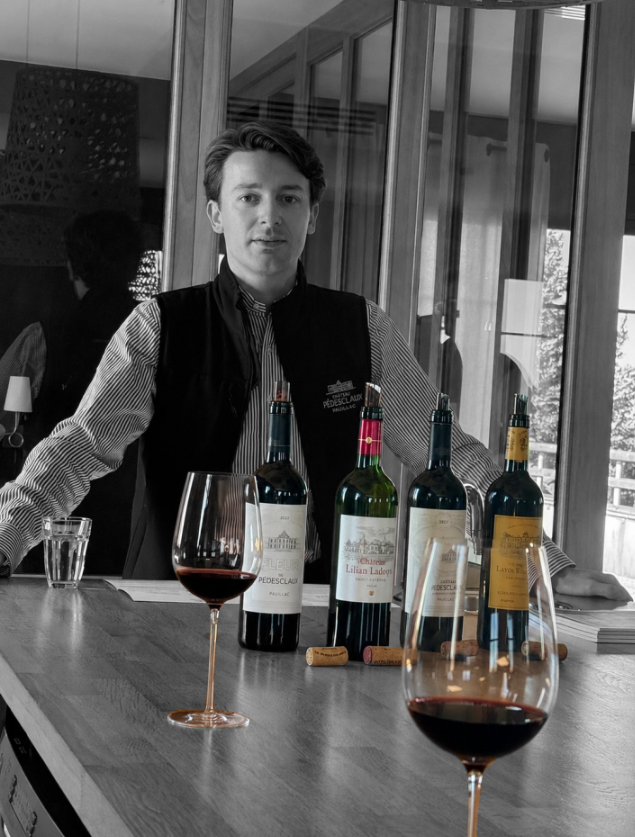
G : Can you tell more about your commercial staff and your family representative, Michaël Militon, who is based in Bordeaux?
LC : Richard Gordon travaille avec La Place depuis plus de cinq ans ; il voyage dans toute l’Europe et l’Asie pour faire déguster nos millésimes, jeunes et anciens. Nous avons également des membres de l’équipe basés en Chine, à Hong Kong et au Royaume-Uni. Michaël Militon se consacre tout particulièrement au travail avec La Place. Il est basé à Bordeaux, et il va également voyager en Europe et en Asie. Nous en sommes très heureux, car il est vrai que pour vendre du vin, il faut ouvrir des bouteilles : les gens doivent goûter nos vins pour en apprécier toute la beauté. Nous sommes donc ravis que Michaël puisse partager nos vins avec les amateurs du monde entier. Et nous sommes très fiers du fait qu’il parle couramment mandarin, après avoir vécu dix ans en Chine. Il est d’origine française, de la région de la Loire.
Distribution Today ans Tomorrow
G: What is your view on the current state of the wine market?
LC: This is a moment when wine sales are down in many parts of the world, including most of Europe, Asia, and North America. In Latin America wine and spirit sales are growing. But there are some decreases in sales in Argentina, related to less tourism because of the exchange rate. In the rest of the world, I’m not completely sure why it is, but I think it’s a combination of things, the economy in many cases but also the anti-alcohol health message might be playing a role in some of the European countries. And there is also the question of the high interest rates which make it more difficult for wine merchants and people in the wine business to purchase wine. My overall view of wine is that it is one of the most beautiful cultural products. Every bottle is a piece of art because, there’s a little more or less oxygen coming in through the cork, so every bottle will actually be distinctive from another, even from the same vintage. And then there’s vintage variability.
We have more diversity in wine than in anything else that we eat/drink. Moderate consumption of wine is one of the greatest life pleasures and the health data shows that in moderation the positives and the negatives balance each other.
G : How can we make wines more appealing to the new generation?
LC : I believe we need to put things into perspective: young adults have never been major consumers of high-end wines. That was already the case in my day. They simply don’t have the means yet—but that comes with time. Today, we’re seeing many passionate wine lovers in their thirties who travel, visit estates, and explore food and wine pairings. Wine still has strong appeal. Learning about wine has also become much more accessible thanks to the internet, WSET courses, sommelier training—and even tools like ChatGPT. It’s never been easier to dive into the world of wine.
But it’s crucial to educate people on the difference between moderation and excess. The wine industry must take a clearer stance on this issue. It should promote responsible messaging, highlight moderation, and firmly reject binge drinking. This also involves adopting good practices: offering water, providing spittoons, and always encouraging moderate drinking during meals. Finally, I fully support the rise of alcohol-free and low-alcohol wines. They can broaden the audience and make wine more approachable for younger generations. Our industry needs to embrace this diversity.


Conclusion
G : You are a woman with more than 1000 ideas a day. Can you tell a little bit more about your project In Defense of Wine and the restaurant you have created at Angélica Cocina maestra?
LC : I created In Defense of Wine to counter the widespread misinformation about alcohol. As a biologist, researcher, and medical doctor, I wanted a platform to clarify the science behind these claims and to share articles that offer a balanced view on the potential benefits and risks of drinking at all levels.
I have a presentation on the website www.indefenseofwine.com which includes data and evidence about cardiovascular benefits, cancer risks and moderation. I also put in In Defense of Wine my responses to some newspapers that I think print misinformation on the science of alcohol and health. Some of my opinions have gotten published.
For example, in the Washington Post. And my main objective is to highlight the science that we do know about alcohol and health but also to ask people to support what we call a randomized control trial on alcohol and health which would give us a more definitive answer. And such a study, UNATI, is being conducted in Spain with people following the Mediterranean diet who will be randomized to either stopping drinking any alcohol for four years or continuing to drink wine, which is today part of the Mediterranean diet. And this will actually give us some very clear answers hopefully about the cardiovascular effects of wine in moderation.
About our restaurant “Angelica-Cocina Maestra”, for a long time, I believed our goal of creating Argentine wines that could stand among the world’s best was already an ambitious one. We have exceptional vineyards in Argentina, and our family has been involved in wine for over 200 years, spanning Italy and Argentina. So the idea of also opening a restaurant that could match the level of our wines felt perhaps too daring.
But then came Alejandro Vigil—an extraordinarily talented winemaker and viticulturist from our team—who opened a small restaurant at his home. It quickly gained national recognition and eventually earned a Michelin star. That’s when I realized: our community has the talent to create a restaurant that lives up to the quality of our wines. And that’s how “Angelica – cocina maestra” was born.
The name carries a double meaning: Cocina Maestra is both a “master kitchen” and a place of learning. It’s also a tribute to my grandmother, Angelica Zapata, who was a teacher. Education has always been central to our family—whether in the vineyard, in the winery, or now in the kitchen.
The concept of the restaurant is simple and bold: Wine First. It’s even our hashtag—#WineFirst. Here, wine takes center stage, and the food is designed to elevate and accompany it, rather than the other way around as in most restaurants. When guests arrive, they’re offered several themed wine menus—usually between seven and ten wines per experience. For instance, the Roller Coaster menu takes diners through an unexpected journey of reds, whites, sparkling, and rosés. The food, a seasonal and locally sourced multi-course tasting menu, includes ingredients from our nearby herb garden and orchard. Receiving both a red and green Michelin star was a tremendous honor. It not only validated our vision but also affirmed the heart of our approach: letting wine lead the way.
G : What is an exceptional wine for you?
LC : For me, the main criteria is that it’s a wine that you never forget. You drink a wine in a particular place with a particular company, and you never forget it. And for sure there is an influence of the place and the moment and the people with you, but there is also something about the wine that makes it unforgettable. I think there’s many wines that can be exceptional from any variety, young wines, older wines. In general, wines that have been particularly exceptional for me have been wines with some age, 10, 20 years in the bottle. But I think it’s also a highly personal thing and there is so much choice, so much great wine out there that every person can have the wine that is exceptional for them. And I think that is one of the most beautiful things in wine: that you can choose your favorite and it could be, different from your friend, your sister, your family members’ favorite.