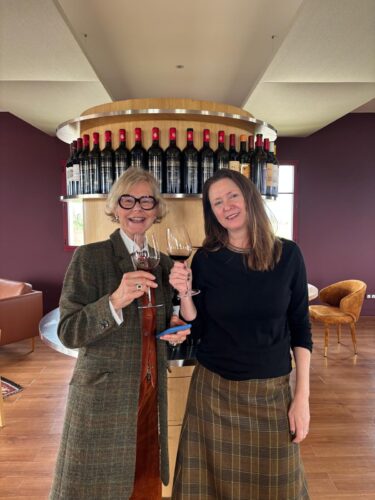
Jean-Charles Cazes
CEO of the Famille Cazes estates and co-owner
&
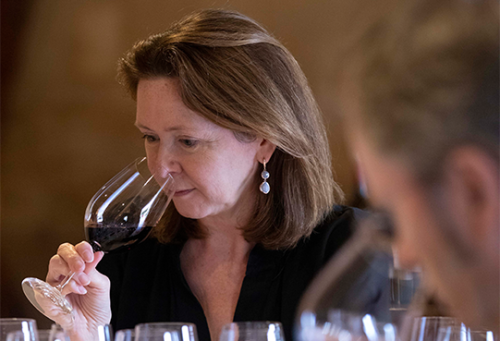
Jane Anson
Wine critic, journalist, founder of the website Inside Bordeaux
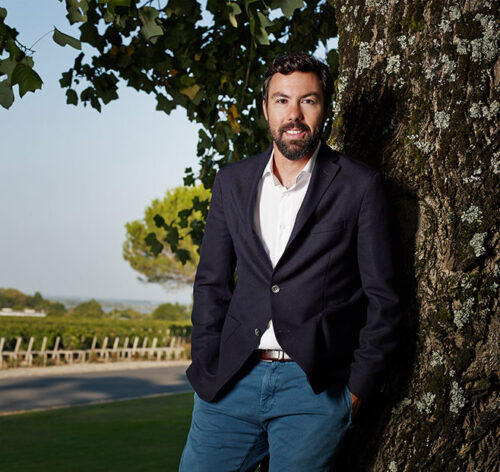
Jean-Charles is the fourth generation of a family of winegrowers who are also accomplished entrepreneurs. He is deeply committed and personally involved, with passion, in each of the family’s projects.
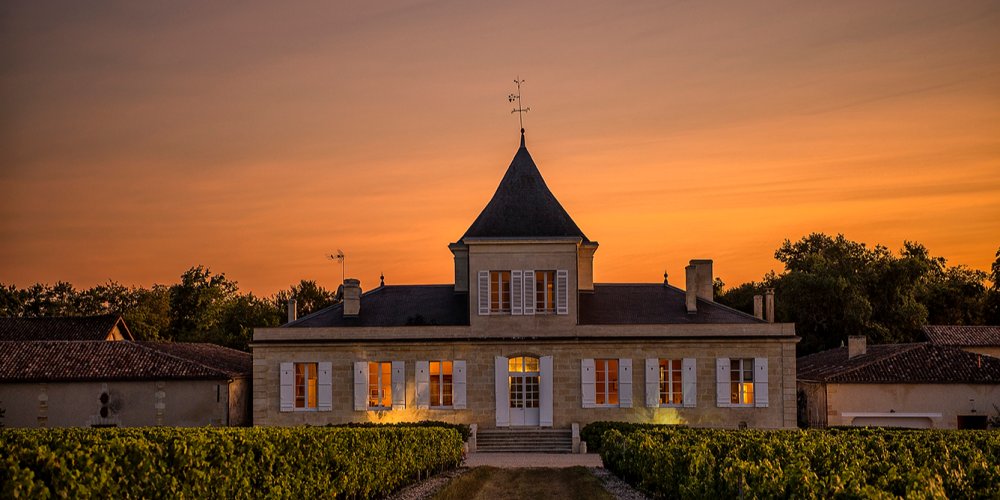
The Cazes family acquired Château Haut-Batailley in 2017. In September 2022, I had the opportunity to speak with Jean-Charles about this Fifth Growth of Pauillac, an interview you can find on our website Inside La Place de Bordeaux.
Today, all 41 hectares of Château Haut-Batailley are planted. Fifty percent of the production is dedicated to Haut-Batailley, and the other fifty percent to the second wine, Verso de Haut-Batailley. As the vines age and precision continues to improve both in the vineyard and in the cellar, the family’s goal is ultimately to reach a ratio of two-thirds Haut-Batailley to one-third Verso.
Although the 1855 Classification allows some flexibility for owners to adjust vineyard surfaces, the Cazes family has no intention of modifying those of Haut-Batailley, even though certain plots border those of Château Lynch-Bages. Their ambition is clear: to restore Château Haut-Batailley to the forefront of the Classified Growths.
In 1940, Jean-Charles’s grandfather acquired Château Les Ormes de Pez in Saint-Estèphe, just one year after purchasing Lynch-Bages. Jean-Charles explained that Merlot plays an essential role in this wine: the richness of the tannic structure is softened by this grape variety, which brings roundness and balance.
Lynch-Bages is undoubtedly one of the great brands of Bordeaux—and arguably of the global fine wine world. What the Cazes family has achieved since acquiring it in 1939 is remarkable, both in terms of winemaking and marketing.
Jean-Charles’s father, Jean-Michel Cazes, was one of the first in Bordeaux to understand the importance of staying connected to the wider world: not only with négociants, but also with importers, distributors, and the final consumer.
Today, the torch is carried by the entire family: Kinou Cazes, Jean-Charles’s sister, based in the United States and very active on social media; Marine Cazes; Catherine Cazes; and even Jean-Charles’s mother, recently in Hong Kong supporting a school and readily presenting Lynch-Bages. And of course, Jean-Charles himself. This is the strength of the family.
The 1990 vintage was the first release of Blanc de Lynch-Bages on the Bordeaux marketplace. Today, it is considered one of the great white wines of the region. Yet the wine has existed since 1969, initially reserved for family consumption and shared with friends—including négociants and distributors.
Because clients often become friends. And as Jean-Charles told me in September 2022, the key challenge for them remains the same: to satisfy their customers.
I have known Jane Anson since 2003. At the end of 2021, she launched one of the finest websites dedicated to Bordeaux: Inside Bordeaux. It has become essential reading for anyone passionate about our wines. Blending expertise, history, and innovation, she shares her tastings and initiatives, such as Mentor Week, to promote Bordeaux wines internationally.
In May 2022, I had the pleasure of asking Jane a few questions for Inside La Place. Her presence at this tasting was a wonderful opportunity to exchange ideas with her about the wines of the Cazes family.
The Cazes spirit
GB : You know Château Lynch-Bages and the Cazes family very well. You have also translated two books for them: Lynch-Bages & Co and Jean-Michel Cazes’s book Bordeaux Grands Crus – The Reconquest. If you had to describe their philosophy, what would it be in your view?
JA : I think there is a real closeness between the Pauillac appellation and their own vineyard. It has been built over many decades of genuine presence on site, of actually living there from the very beginning of their ownership of Lynch-Bages, which is quite unusual. There are other 1855 Classified Growth estates where families live on-site and are involved in local life, but they are in the minority. Because André Cazes was mayor of Pauillac for forty years, and also because they had created an insurance business, they knew the people of the region in a different way. They developed long-term relationships with the local community. I believe this gives them a closeness and a love for Pauillac that you can feel in the wines. That is very important, and I truly appreciate that even today, when the wine is much more expensive, there is still the feeling that this is a family estate that genuinely cares about what it produces.
GB : The Cazes family is known for a rational approach to their profession. Would you agree that this is one of their strengths?
JA : Yes, I agree. It comes back to the idea that these estates are not just investments, but places where they live and where they are deeply rooted. This helps them not only to manage but also to care. They care about the people who buy their wine. There is a real connection between the family and the people they make the wine for. That is something deeply ingrained. If you think of estates like this, Château Léoville Barton also has that feeling. It creates trust in the people behind the wine. In difficult times like today, that makes a huge difference.
GB : Jean-Michel Cazes was the driving force behind this approach in Bordeaux.
JA : Yes, and Jean-Michel was one of the first to open the doors of his estates to welcome visitors. One of the reasons they created Cordeillan-Bages was that he hosted so many people for lunch that, eventually, his wife told him: “Could you perhaps open a small guesthouse somewhere to accommodate all these people?”
What is interesting about Jean-Michel is that he did not rely solely on La Place de Bordeaux to promote his wines. He got on planes, went out to meet people, shook hands, and did the work—something many other wine regions did naturally, but Bordeaux had not really embraced. Bordeaux has had a few figures in its history who did this, such as Arnaud de Pontac, who sent his son to London in 1660. There have been a few historical figures like that, but not many. I would place Jean-Michel Cazes in that same lineage as Arnaud de Pontac. Alongside other figures such as Baron Philippe de Rothschild and Elaine de Lencquesaing in the 20th century, who understood that the fine wine market is an emotional one. Why do people spend a lot of money on wine? Because they feel something—an emotion. You don’t feel emotion through a simple phone call. You feel it sitting next to someone, sharing a bottle at the table. That is what makes the difference: the story, the emotion, and of course the quality in the bottle—but it goes far beyond that.
Today, in times of economic difficulty, people realize they cannot rely on others to do the work for them—they must do it themselves. The estates that are performing best in the current slowdown are those that give people a reason to keep buying their wines. The Cathiard family is also a good example. They have a face. People fall in love with their story at Château Smith Haut Lafitte.
GB : The role of the négociant remains important.
JA : Yes, extremely important, as it has always been. There is probably no one better in the entire commercial world when it comes to logistics and understanding all the different layers of the market. They have the ability to be highly responsive: this market may not be doing well, but we know—because we’ve been there—that another market is performing better. This ability to stay connected through networks remains essential. Over the past fifteen years, when markets were so dynamic—especially in China—châteaux may have forgotten how important this capillary system is. But it must be a partnership with their primary client, which is the négociant. It is certainly a delicate dance, but this partnership is the strength of La Place de Bordeaux.
The wines
GB : In your opinion, is Château Lynch-Bages the greatest brand in Bordeaux?
JA : Bordeaux is a vast region with peaks of excellence in every appellation. That is Bordeaux’s true strength, and there is no doubt that Lynch-Bages is among these great names, on the same level as the First Growths.
GB : Do you think Lynch-Bages has gained in precision since the wine has been vinified in the new 21st-century winery?
JA : Not only because of the new winery. I would say that from 2009/2010 onwards, you could already feel a much greater precision in the wines. They started doing much more work in the vineyards, using more technological sorting methods, as well as increased use of GPS to determine where to intervene in the vines. You could already notice a difference. They strengthened selection and increased the proportion of the second wine. You could see—as with the 2014 we tasted—that one of the reasons it is so good, in my view, lies in these new processes they were focusing on. By the time you reach 2020, the first vintage vinified in the new winery, there is an additional qualitative leap.
GB : How does this qualitative leap translate in the wines?
JA : I would say that today, the wine can sometimes feel more powerful in its youth. What Jean-Charles said about his grandfather is really interesting—that he would always wait a week after Latour before starting the harvest. The wine used to have a form of generosity. Today, in more recent vintages, the wine also has a true Pauillac style. It has shoulders, a real sense of gravity, and notes of licorice. It always had this to some extent, but today there is greater precision.
GB : Jean-Charles mentioned that Lynch-Bages has more “drinkability” in its youth?
JA : For me, not necessarily for Lynch-Bages itself. I think Lynch-Bages will always age exactly as it has done historically, and I see it as a serious wine in many vintages. What is interesting, however, is that today there is much more precision in Echo de Lynch-Bages and Château Les Ormes de Pez than before, and now also in Verso de Haut-Batailley and Château Haut-Batailley. It is very clear that Verso—and probably Haut-Batailley—can be enjoyed earlier than Lynch-Bages. Ormes de Pez is such a beautiful wine in this range because it can be drunk immediately while also having aging potential. My impression is that today it is much clearer than before which wine in the range suits each moment.
GB : It was also very interesting that Jean-Charles said during the tasting that they want to keep Haut-Batailley as a Fifth Growth and do not want to modify any vineyard surface that could be added to Lynch-Bages.
JA : Yes, indeed. It must be very tempting to do so—with all these newly planted plots, they could integrate them directly into Lynch-Bages. I am actually very impressed that they chose not to. But it once again shows how thoughtful their approach is, considering what will work in the market as well as what suits the personality of each wine.
GB : What is your overall impression of the wines from the Famille Cazes estates? Do you think there is a “Cazes style”?
JA : Yes, I do. There is this combination of generosity and warmth with precision, and a strong awareness of the character of the appellation, which I love. I appreciate when a wine tastes of its place of origin. Lynch-Bages, especially wines like the 2014, is very Pauillac. Haut-Batailley is less of a classic Pauillac than Lynch-Bages, but I enjoy it greatly as well. As Jean-Charles said, it is closer in style to Saint-Julien than Pauillac, as it is slightly lighter and more approachable. That is the true signature of the Cazes family: they are happy and proud to represent the identity of their appellations.
GB : That is also the case for Les Ormes de Pez.
JA : Yes, in a beautifully old-school way. It is a charming, contemporary expression of what “old-school” can be, because it is also very appealing. This wine is among the five best value-for-money wines in Bordeaux. It is incredibly consistent, delicious, and offered at a very fair price for what it delivers.
The wines of the Cazes family always have a certain ease; they have a sense of place. There is no reason why people should not be able to understand them.
GB : The first wine we tasted was Verso de Haut-Batailley 2020. It was interesting that Jean-Charles mentioned that, for this vintage, the young vines were not yet in production. It is the second selection from the historic Haut-Batailley vineyard. What do you think of this wine?
JA : Verso is, at this stage, the wine that feels the least homogeneous in the range. It is one of the wines where you can sense that the entire process is still evolving.
GB : There is still some way to go.
JA : Exactly. For Haut-Batailley itself, I already perceive a signature at this stage, with this idea of a slightly sculpted, lighter style—and you can taste it. You cannot miss it in the glass. It is obviously different from Lynch-Bages. For Verso, I am not yet entirely sure what I have in the glass, unlike with the others.
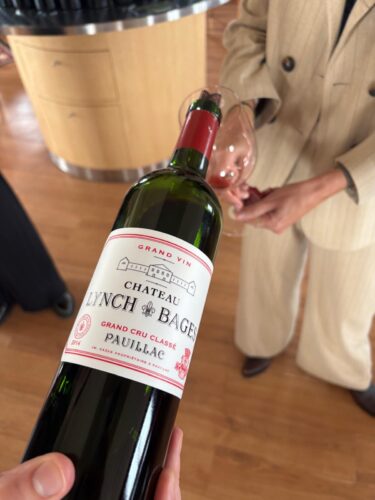
GB : We tasted Château Haut-Batailley 2018, a warm and sunny vintage.
JA : I enjoyed it, but Haut-Batailley is better today. I can clearly see the differences, and 2018 was only the family’s second year of ownership. Today, I truly see the evolution of what the family is doing at Haut-Batailley.
GB : In what way do you perceive this evolution?
JA : The 2018 was not really a Pauillac wine. It was more in a “2018 style,” whereas today I think the wine is a more sculpted version of Pauillac. I have felt this since the 2020 vintage. It didn’t take long—I now have a clear idea of its personality.
GB : Haut-Batailley certainly has a bright future. And the next wine, Château Les Ormes de Pez 2020?
JA : I have great admiration for what they are doing at Les Ormes de Pez. It is a wine I truly like. I buy it for myself and enjoy sharing it with friends. It is a wine I always look forward to tasting—and that is a good sign, because I taste it regularly and I am always happy to see it in a lineup.
GB : Regarding Château Lynch-Bages 2014, you wrote that it was the wine of the year, but you also said during the tasting that it is not always the greatest wine.
JA : That means it is the wine that surprised me the most. It is a wine I want to highlight to my subscribers—to tell them: don’t miss this one. It is a wine to seek out and buy. I don’t like publishing only 100-point wines from the most recent vintages. I much prefer showing people: here is a truly brilliant wine you might overlook, or perhaps never noticed at the time. That is how I feel about this 2014. I tasted it during a blind vertical with the Lynch-Bages team. We all thought—including the winemaker and Jean-Charles Cazes—that it was a 2016. That is why it is so good.
GB : That is one of the great strengths of Lynch-Bages: you are never disappointed by the wine.
JA : Yes, exactly. We are fortunate in Bordeaux to have estates like Lynch-Bages that maintain belief. People can sometimes feel disillusioned with Bordeaux—it happens. But certain wines, like Lynch-Bages, help people stay connected to Bordeaux. This 2014 is so Pauillac, and at the same time it is a classic Lynch-Bages.
GB : The next wine was Lynch-Bages 2019. Jean-Charles said something remarkable about this vintage. First, he highlighted the tremendous effort of the Union des Grands Crus, which managed to send barrel samples to journalists and buyers around the world during the Covid lockdown—a very difficult task. And second, that Malou (Le Sommer, former managing director) and he were almost emotionally moved by the very positive market response.
JA : At that time, I was the only wine critic working for Decanter based full-time in Bordeaux and able to taste all the wines. At Decanter, we were very fortunate to publish a broader range of en primeur scores. Other critics only had access to the top wines. I have a very vivid memory of sitting in my kitchen, tasting everything, receiving deliveries in the garage. It is a great vintage with a lot of value. I think 2020 is slightly more homogeneous and a bit more concentrated overall—so in general, 2020 is better than 2019. But 2019 is extremely well balanced and delicious. It does not need much time before being enjoyed.
GB : The final wine: Blanc de Lynch-Bages 2024.
JA : Blanc de Lynch-Bages represents one of the first major steps when Jean-Charles returned to work alongside his father. He brought his own vision to the wine—implementing precise temperature control for each barrel and carefully shaping the style he wanted. He truly worked hard to redefine the profile compared to what it was before his arrival. I think he has done a fantastic job. You can see it clearly in this 2024, which is absolutely delicious.
GB : In what way has Blanc de Lynch-Bages changed since Jean-Charles introduced these developments?
JA : It is all about precision. It has the right level of freshness without losing the structure a white wine needs. Together with the team, including Nicolas Labenne, they have made it one of the great white wines of Bordeaux. And there are not many—only a handful that truly stand out. Blanc de Lynch-Bages now sits alongside Y d’Yquem, Pavillon Blanc du Château Margaux, and of course the white wines of Château Haut-Brion and Château Lafleur. There are not many wines for which you can truly say they are Bordeaux whites capable of rivaling the great wines of Burgundy, the Loire, and other top French whites. Blanc de Lynch-Bages is genuinely impressive.
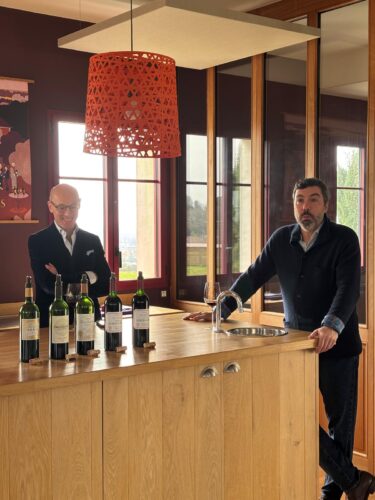
Spotlight on Inside Bordeaux
GB : It was in May 2022 that I spoke with you about yourself and your website Inside Bordeaux. Now, almost four years later, are you satisfied with that decision?
JA : Yes. I launched Inside Bordeaux in September 2021, and it is certainly the best thing I have done in my career. I felt it was the right moment and that I had the depth of knowledge needed for this kind of platform. And there simply wasn’t anything like it. I have always been careful to ensure it is not just about scores. I don’t do it alone—Sarah Kemp joined me. I love doing the podcasts with Wine-Searcher, the Wine Voices. Hundreds of thousands of people receive this newsletter every week. It expands my reach and further strengthens the association of my name with Bordeaux. That is exactly what I need, because that is the purpose of my site. If you start talking about Bordeaux, where should you go? You should come to my site. That is its entire goal. It is good to go deep into one specific field.
GB : When you go that deep into a single subject—which, in my view, is your strength—is it difficult to maintain independence?
JA : I was a journalist for ten years before becoming a wine journalist. The idea of independence is deeply rooted in how I approach things. I think the more you taste within a region, the more you see what works and what doesn’t. It would be impossible to be universally positive about everything when you go that deep. A, it wouldn’t be interesting, and B, it would be too obvious. I actually think it is easier to remain truly independent when you know a place extremely well.
GB : What is the most difficult part of your work?
JA : I always try to think about what is most useful for my subscribers—what truly benefits them. It is challenging to constantly ensure that you are delivering the most useful content. That is why feedback from subscribers is so valuable. Also, media is changing rapidly, and so is the wine world. Any platform with staff must consider what people are willing to pay for, especially now that so much information is available through AI. You can ask ChatGPT, and it will tell you a lot. Fortunately, I have my background as a journalist. I have never thought, “I’ll just give three quick points people can skim in a second,” which is typical click-driven content. Getting a quick, simple answer no longer really makes sense today—it gives you anecdotal information without depth. The real question is: how can I be different and go deeper, adding real context? It’s about finding the right subjects—that’s old-school journalism, like what Jean-Michel Cazes did in the 1970s: doing the groundwork, taking the time, not choosing the easy route. That is what I try to do, as naturally as possible—but it does take time.
We are now preparing the 5th edition of Mentor’s Week. Last year, we won the award for Best Initiative in Education and Knowledge Sharing from Vinexposium. It has been a real accelerator and has brought me so much. I simply love spending a week with these brilliant young people from around the world.
GB : That must also be inspiring.
JA : Yes, absolutely. It is incredible. There is also Connoisseur Week. I instinctively felt that the way to approach the market is through experiences—that is what Bordeaux needs. People need to feel closer; there needs to be an emotional connection. Connoisseur Week is very useful for that. I organize it with Sarah Kemp, and it is very enjoyable.
Each link in the chain leaves it to the next to connect with the final consumer. Today, the difference is that everyone on La Place is becoming aware of this. Someone has to fall in love with these wines—that is what ultimately needs to happen. And having faces behind the wines, like the Cazes family, makes all the difference.
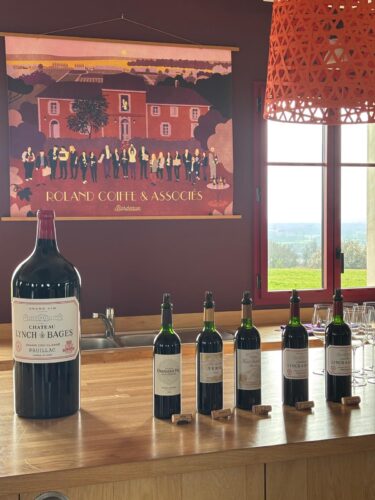
The wines tasted
Verso de Haut-Batailley, Pauillac 2020 :
A wine still under construction, considered the least homogeneous in the range according to Jane Anson. Its style is not yet fully defined.
Château Les Ormes de Pez, Saint-Estèphe 2020 :
A very consistent, delicious wine offering excellent value for money. Enjoyable when young but also capable of aging.
Château Haut-Batailley, Pauillac 2018 :
A good wine, though still marked by the vintage style. The true personality of Haut-Batailley is more evident in more recent vintages.
Château Lynch-Bages, Pauillac 2014 :
A major success and a standout surprise in the tasting. A classic Pauillac that was mistaken for a 2016 in a blind tasting.
Château Lynch-Bages, Pauillac 2019 :
A balanced and very enjoyable vintage. Less concentrated than 2020 but approachable relatively early.
Blanc de Lynch-Bages, Bordeaux Blanc 2024 :
A highly precise, fresh, and well-balanced wine. Considered one of the great white wines of Bordeaux.