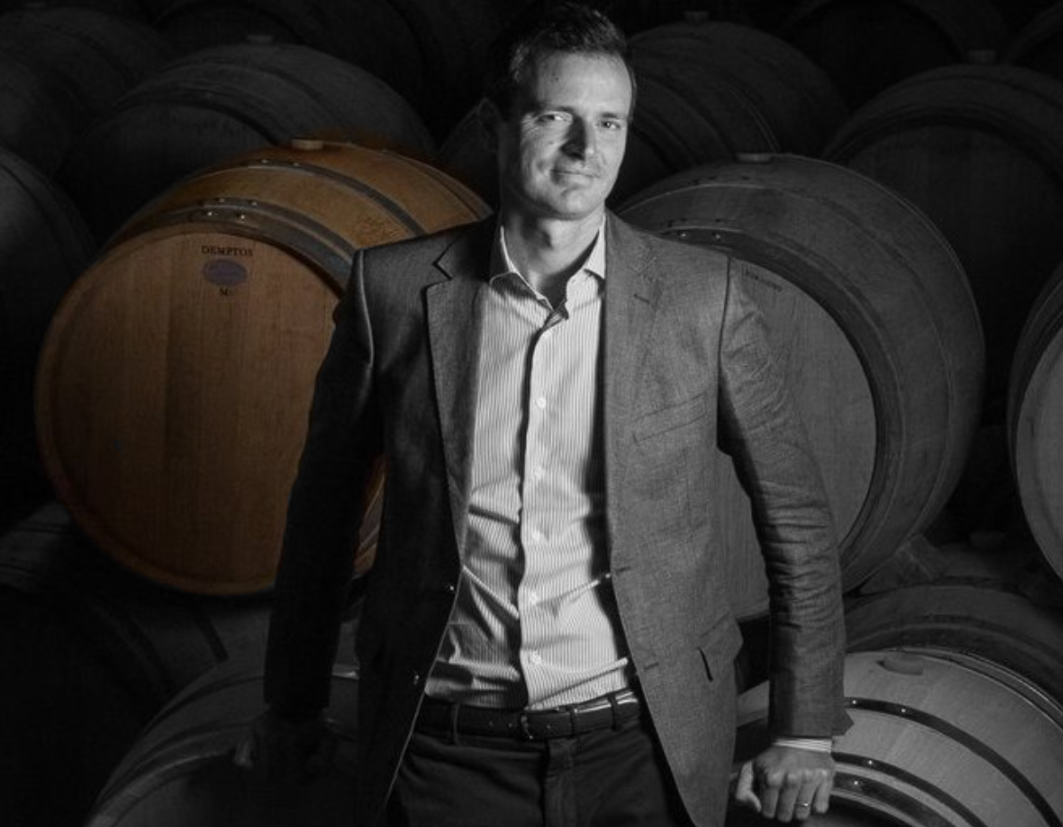
Charles Thomas
Commercial Director of the Château Cos d’Estournel and Domaines Reybier
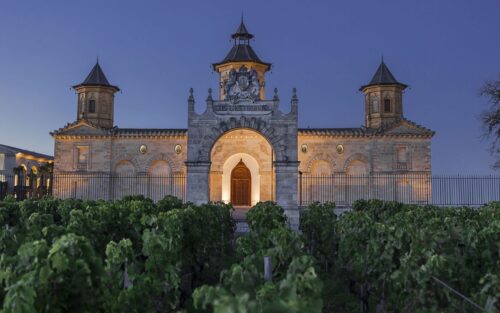
Cos d’Estournel : Protected Terroir, Parcel Precision, and a Signature Style
Gerda Beziade : Charles, in your view, what are the most distinctive commercial arguments of your brands—the ones that deserve even greater emphasis?
Charles Thomas : First of all, for Cos d’Estournel—which you’ve visited several times—there is, of course, the terroir. It is magnificent, located at the very northern tip of the Médoc, and above all protected from climatic hazards, whether frost or extreme heat.
We benefit from a large body of water nearby—the Gironde estuary, about eight kilometers wide at this point—which acts as a thermal regulator. The vineyard is therefore relatively frost-resistant. The estuary has protected us on several occasions during frost episodes in the Médoc. We are never in extreme conditions; we consistently achieve balanced outcomes.
What is striking—and we see it again with the upcoming 2025 vintage—is that even in hot years like 2018 or 2022, we still manage to maintain moderate alcohol levels, around 13%. That is also part of the magic of Bordeaux. Despite rising temperatures in recent years, there can be a phenomenon of vegetative blockage that limits sugar accumulation. The result: wines with very controlled alcohol levels. Much of this is due to our climate and our northern Médoc location.
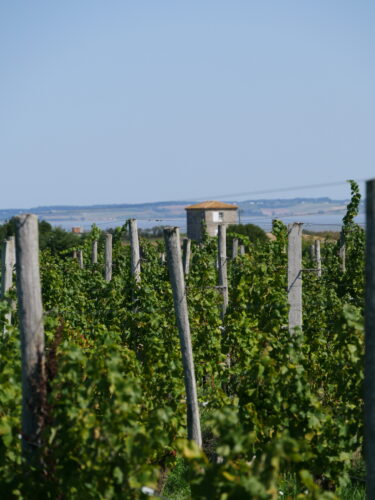
This estuarine protection also applies to G d’Estournel and Cos Blanc, which are even further north—about 25 kilometers from Cos—at the tip of the estuary. There, we are roughly ten kilometers from the Atlantic Ocean and just a few hundred meters from the Gironde, which reaches about ten kilometers in width at that point. Here again, climatic regulation is essential, particularly for preserving acidity.
Next, there is the very nature of the terroir. “Cos” means “hill of gravel” in old French. We have superb gravel rises with excellent exposures, mainly east and north-northeast. By contrast, Cos Labory is more west-facing—these subtle differences in exposure create genuine variations in expression, which are then reflected in nuanced aromatic profiles in the glass.
Added to this is the vision of the owner, Mr. Reybier, who arrived in 2000. He was among the first in Bordeaux to equip the estate with a gravity-flow cellar. The idea is simple: intervene as little as possible between harvest and final wine, in order to express the terroir as faithfully as possible.
This cellar is not a marketing showpiece designed to impress. It is a tool, almost in the architectural sense—like Jean Nouvel said about his renovation of the Lyon Opera, “a tool reduced to the expression of its function.” It is entirely designed to serve the wine.
Thanks to this tool, despite the estate’s significant size, we can work with remarkable parcel-level precision. We have numerous individual vats, allowing us to taste one sample per vat during blending, before Christmas—nearly 80 samples.
This gives us an extremely fine reading of the terroir and great precision in blending. That, today, is truly our key differentiating factor.
At a time when there is a growing search for terroir singularity and earlier drinkability, the combination of geographic and technical elements described above enables us to fully meet consumer expectations.
GB : As for Pagodes de Cos, the second wine of Cos d’Estournel, is it based on parcel selection or selection after tasting?
CT : Pagodes de Cos was created in 1994. We celebrated its 30th anniversary in 2024 with a special bottling.
Around 90% of the wine comes from parcels historically dedicated to Pagodes. The remaining 10% varies depending on the vintage—it is an adjustment component, decided after tasting.
There is always a higher proportion of Merlot in Pagodes than in Cos d’Estournel, which gives it a more accessible, more immediate style. In fact, I prefer to speak of it as an “alternative wine” rather than a “second wine.” Pagodes has its own identity. The average vine age is over 40 years, which further distances it from the traditional notion of a Bordeaux second wine and gives it real depth.
Beyond parcel origin, there is above all a gustatory philosophy. Each year, during tastings for the new vintage blends, we follow a precise aromatic profile that we aim to maintain. There is stylistic continuity and consistent accessibility for Pagodes enthusiasts.
GB : It’s somewhat similar to the approach of the great Champagne houses.
CT : In a way, yes—but wine will always remain a reflection of the vintage.
GB : For Cos, however, the impact of the vintage is certainly more pronounced.
CT : In Bordeaux, we are fortunate to have vintages that are very distinct from one another. The oceanic climate sets the rules: some years are very warm, others much wetter—we can have two months of rain. This variability, historically characteristic of Bordeaux, also partly explains the “yo-yo” effect of prices, often linked to the perception of vintages.
What I find remarkable is that a vintage considered lighter or less солне—such as 2017 or 2021—can prove more accessible in its youth. Conversely, iconic vintages like 2010, 2016 or 2022 generally require more patience—five to ten years, more often than not.
That said, in every vintage, Cos d’Estournel retains a distinctive backbone, notably driven by Cabernet Sauvignon, which brings those spicy, slightly peppery notes that emerge after a few years of ageing. Our wines always return “home,” sooner or later.
What changes from one year to another is the style of the vintage—never the quality. As we discussed earlier, the resources and expertise deployed are entirely dedicated to excellence.
GB : How do you interpret the impact of climate change on the style of vintages?
CT : If we go back 50 years, there may have been one or two great vintages per decade. Today, it is almost the opposite: only two or three years per decade are less remarkable.
Climate change is evident, but there are other factors as well. Cabernet Sauvignon ripens much more reliably, and we have made real technical progress: better understanding of parcels and soil behavior, adapted vinification methods, and technological tools that allow for cooler, shorter macerations.
So climate and technique combine to improve quality. It may not be politically correct to say so, but climate change is currently helping us produce better wines.
GB : Cos d’Estournel is known for its remarkable ageing potential, but everything you’re saying also suggests that its drinkability at a young age has improved.
CT : Exactly. Two factors explain this. First, the climate: Cabernet Sauvignon now ripens more consistently than before, reducing the risk of vegetal notes and bitterness.
Secondly, there is a broader movement in Bordeaux toward gentler, cooler macerations, resulting in wines that are more digestible and approachable in their youth.
Consumption habits have also changed. The consumer has changed—the world has changed. Today, many clients want to enjoy their wines sooner. Bottles are no longer necessarily stored in cellars as they once were. Consumption is more immediate: a wine must be drinkable young while still retaining its quality and overall sensory expression.
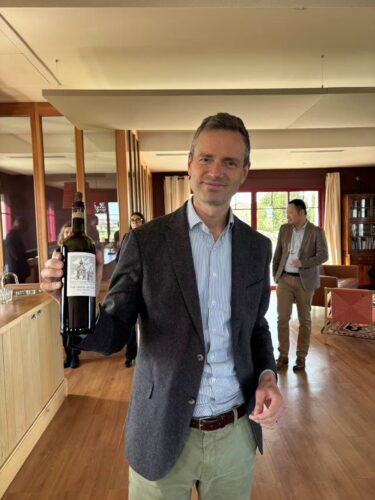
Domaines Reybier: G d’Estournel, Cos Labory Reborn, Focus on Organic Farming and the 2025 Vintage
GB : In your February 2022 interview, you said you were proud because it was the first time you offered five wines en primeur, including G d’Estournel. If you had to sum up this wine in a few compelling sentences, what would they be?
CT : With G d’Estournel, we now take a different approach: we work through market exclusivity. Each market and each négociant receives its own allocation in order to protect distribution within a given market and avoid the competitive practices of the open market, which can destabilize pricing.
G d’Estournel deserves greater attention from the trade. It is a wine that brings together everything consumers are looking for: pleasure and immediacy, without over-intellectualisation.
We already have several markets open across Asia, Europe and the United States. In my view, this is the future for this type of wine: “distribution-driven” wines, but always through our partners and négociants of the Place de Bordeaux. Your clients and readers should not hesitate to support the implementation of this approach.
GB : Why “more distribution-driven”?
CT : This very Bordeaux term is something of a catch-all—it can mean everything and nothing. It relates to both the aromatic profile and, inevitably, the price. We aim for a wine that is enjoyable from a young age, very Merlot-driven, with subtle oak influence—fruit-forward and accessible.
GB : Can you tell us more about the terroir and vineyard size of G d’Estournel?
CT : We have around twenty hectares located 25 km north of Cos d’Estournel. When we first acquired it, the wine was called Goulée, named after the Port of Goulée. It’s a beautiful site: the Dutch drained the marshes there in the 17th century.
The gravel ridges are slightly less deep than in Saint-Estèphe or Pauillac, with a bit more clay and a cooler climate. Merlot thrives there and dominates the blend at 75–80%.
The white vineyards, from which we produce Cos Blanc, cover around ten hectares, some with excellent limestone qualities. This brings great freshness and ideal acidity to the white wines.
GB : In 2023, Mr. Reybier acquired the neighboring Cos Labory. How do you intend to differentiate this wine?
CT : Cos Labory covers 35 hectares, a significant portion of which lies on the Cos plateau, close to Cos d’Estournel. The exposure is different—more west- and north-facing—which gives it a distinct character.
We know the plateau terroir well, but it takes time to fully understand its nuances. We now have three years of hindsight and have launched in-depth soil studies to refine our understanding.
The first vintages fully reflecting the Reybier era are 2023, 2024 and 2025. We carried out a parcel study, improved grape reception with cooled systems, shortened maceration times, reduced pump-overs, and limited new oak usage to around 20%. The goal is a more accessible, harmonious and elegant wine, with refined tannins.
GB : In the 1855 classification, it’s the name that is classified, not the terroir. Does that give you a certain level of freedom?
CT : Yes, and for now we are focused on quality. Cos Labory no longer has a second wine: vats that do not meet our standards will be sold in bulk. It is a Fifth Growth, like Lynch-Bages or Pontet-Canet. Elevating this estate will take time—and we only get one chance per year to prove it.
We are very pleased to present the 2025 vintage, which is outstanding. We know conditions are challenging: some brands are less anticipated en primeur than others. But we are fortunate to rely on Cos to help raise awareness of Cos Labory.
GB : What has historically been the main market for Cos Labory?
CT : Cos Labory was mainly distributed in France. When I travel to the United States, Asia or across Europe, I see that people know Cos d’Estournel—but often overlook Cos Labory, and don’t necessarily taste it.
We therefore have tremendous growth potential in markets that have been underdeveloped until now.
We produce around 5,000 cases. The terroir is magnificent, but the wine has not been widely promoted. There is real work to be done in terms of communication and commercial effort.
GB : What investments have you made at Cos Labory since the acquisition?
CT : We have invested both human and technical resources to study the soils, replant where necessary with more suitable grape varieties depending on the terroir—and that takes time. Truly understanding an estate and how its terroir reacts is a long-term process.
The vats are in excellent condition and fully operational, and the setting itself is superb. More than that, it was a family home, and there is a real sense of belonging there.
GB : So the acquisition of Cos Labory was an opportunity not to be missed for Mr. Reybier?
CT : Absolutely. Cos Labory carries the name “Cos,” and historically it belonged to Louis-Gaspard d’Estournel in 1847, which adds a strong heritage dimension. In 2016, Mr. Reybier also acquired the residence of Louis-Gaspard d’Estournel—the Maison d’Estournel—which we have since transformed into a hotel.
When we acquired Cos Labory in 2023, we were, in a way, completing the historical legacy of Louis-Gaspard d’Estournel.
GB : What future projects are you currently working on?
CT : We have major projects regarding vineyard management: all our estates are currently undergoing organic conversion.
GB : Why did you decide to take this direction?
CT : First of all, we don’t like to communicate too much about it, because it is above all a conviction—not a marketing tool. But it is an important and exciting project. Workers are even more involved in the vineyards, which has a real social impact.
In organic farming, we use products that are more respectful of both the environment and the teams. It requires us to be more attentive to the vines, to observe how they react. This approach creates a more intuitive and intimate connection between the worker, the vineyard manager and the vine itself. It is something we had not fully anticipated, and it is very interesting from both a societal and social perspective.
We have been working on this for several years. The owner is keen that it should not become a communication tool—it is a conviction, a commitment to passing on the estates to future generations. It is a necessary step, but not a sufficient one.
GB : Can you tell us a few words about the 2025 vintage?
CT : We are delighted with this vintage. Yields will be relatively low, but 2025 is shaping up to be exceptional. It is a surprising vintage, with remarkable smoothness and accessibility.
Despite the heat and water stress we experienced, alcohol levels remain reasonable. That is the magic of Bordeaux: even with repeated heat and significant water stress, the wines remain digestible and elegant. Our 2025 combines harmony, density and energy, without any excess.
GB : That may be the key difference compared to 2022, which was also hot and dry, but with higher alcohol levels.
CT : 2022 was above all more opulent aromatically, with slightly higher alcohol, indeed. In 2025, as in any vintage affected by water stress, the leaves stop functioning, less glucose is formed, and therefore less alcohol. It is a physiological phenomenon linked to the vintage.
We did, however, experience the end of the heat following rainfall at the end of August, which is a notable difference compared to 2022.
The result? We expected something more opulent and exuberant—but it is quite the opposite. The wine is fine and very delicate. It has everything, but without excess.
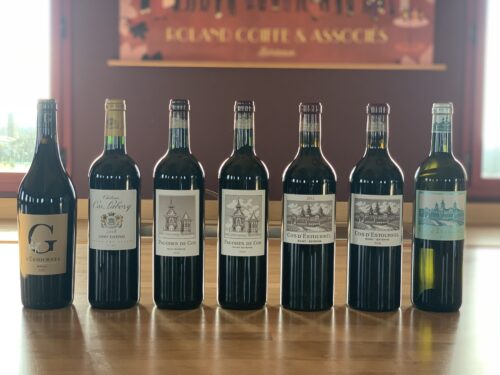
The Wines Tasted
G d’Estournel 2022 :
67% Merlot, 29% Cabernet Sauvignon, 3.6% Cabernet Franc and 0.4% Petit Verdot.
Charles is right—this is a seductive wine. It opens with everything you love in a great Merlot… made in the Médoc: almost creamy, yet with a firm backbone. A wine that appeals to everyone, even consumers who are not typically Bordeaux enthusiasts, thanks to its generosity and the guidance of the Cos d’Estournel team.
Cos Labory 2018 :
54% Cabernet Sauvignon, 38% Merlot and 8% Petit Verdot.
A солне vintage, 2018 suits the style of Cos Labory particularly well. The wine fully expresses the structure of a Saint-Estèphe—rather masculine, with deep black fruit supported by fine balance. The tannic framework is present and structuring, bringing both character and length.
Pagodes de Cos 2020 :
58% Cabernet Sauvignon, 34% Merlot, 4% Cabernet Franc and 4% Petit Verdot.
The vines have an average age of 40 years. It is fair to say this wine is another expression of Cos d’Estournel, with the same stylistic backbone. It shows notes of black fruit cream, and on the palate, the generosity of the vintage is evident. It is indulgent yet very well balanced, with freshness carrying the wine through to a long, elegant finish.
Pagodes de Cos 2016 :
50% Cabernet Sauvignon, 46.5% Merlot, 3% Petit Verdot and 0.5% Cabernet Franc.
2016 is, alongside 2010, undoubtedly one of the greatest vintages in terms of classical Bordeaux nobility. It has everything. Blind, one recognizes the Cos style—but it can be misleading, as the wine goes far beyond a “simple” second wine. It is deep, perfectly balanced, and at times words fall short—so I decided to buy a case.
Cos d’Estournel 2012 :
75% Cabernet Sauvignon, 22% Merlot, 2% Cabernet Franc and 1% Petit Verdot.
Cos d’Estournel always shows spicy aromas, which are present here alongside red fruit. Menthol and cedar smoke notes also emerge. The wine is beautifully balanced, framed with elegance, and finishes with persistence and charm.
Cos d’Estournel 2018 :
74% Cabernet Sauvignon, 23% Merlot, 2% Cabernet Franc and 1% Petit Verdot.
This is the wine of the vintage according to Jane Anson—and I agree. Here is what she wrote:
“Almost perfect. Just across the border from Pauillac into Saint-Estèphe, Cos d’Estournel under Michel Reybier is, for me, the wine of the 2018 vintage in Saint-Estèphe. Perhaps because it often reveals notes of spice—turmeric, cinnamon, saffron—and finding them in 2018 feels true to the estate’s aromatic signature, rather than overly marked by the conditions of the vintage.”
The wine shows both complexity and power, with notes of plum, fig, blackcurrant and blackberry, supported by structured tannins. The freshness of the acidity on the finish provides real momentum. It is an ambitious, powerful wine that fully embraces its stature.
65% of the production was included in the grand vin. 50% new oak (slightly less than the usual 60%).
Cos Blanc 2020 :
66% Sauvignon Blanc, 34% Sémillon.
Thanks to the limestone soils and its location near the estuary, the vines did not suffer in 2020. The wine displays classic Sauvignon aromas—citrus, flowers and white fruit. After around six years, the Sémillon becomes more expressive, revealing notes of pineapple and mirabelle plum. The wine is precise, with a beautiful salinity. A great white wine… even the Burgundian, Charles Thomas, would have to admit it.
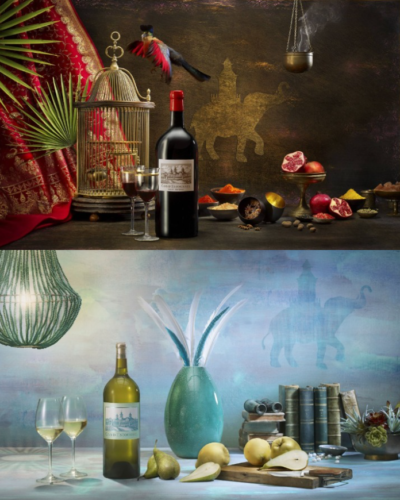
In summary:
- Exceptional terroir in the northern Médoc, protected by the Gironde → natural balance and freshness, even in warmer vintages
- Consistent aromatic signature: spice, precision and elegance, driven by Cabernet Sauvignon
- Gravity-flow winery & ultra-precise parcel work: pure expression of terroir, with no artifice
- A clear and complementary range:
- Cos d’Estournel: grandeur, depth, ageing potential
- Pagodes de Cos: its own identity, controlled accessibility
- Cos Labory: powerful, deep black fruit, more structured and masculine
- G d’Estournel: modern Bordeaux, fruit-forward and immediate
- Cos Blanc: freshness, tension, a great estuary white
- A long-term vision under Michel Reybier: organic conversion (first certified vintage in 2026), and the revival of Cos Labory
These are elegant, digestible and sustainable wines—capable of seducing today while standing the test of time.